
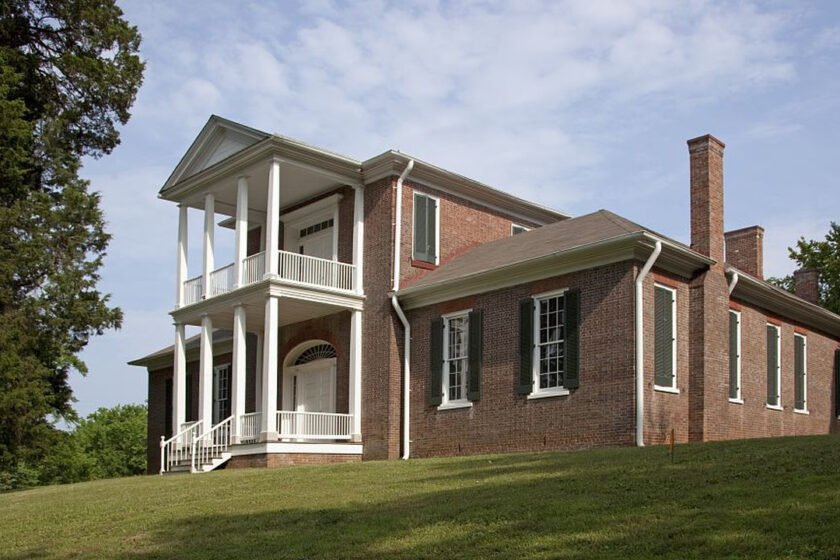

Tucked into rural corners and fading towns, Alabama’s antebellum homes once stood as proud testaments to wealth, ambition, and Southern craftsmanship. Built before the Civil War, these estates reflected not only architectural excellence but also the social and economic complexities of their time. Many have since been forgotten—some abandoned, others quietly preserved by local hands. Yet their columns, porticos, and fading facades continue to whisper stories of a world that has long since passed. These homes, whether in ruin or restoration, remind us of the layered legacy that shaped the Alabama landscape.
1. Elm Bluff Plantation (Dallas County 1845)

Once spanning over 5,000 acres and worked by over 200 enslaved people, Elm Bluff was among the most influential plantations in its region. The Greek Revival mansion once stood tall along the Alabama River. Today, the structure lies in ruins, overtaken by nature and largely forgotten, a haunting symbol of antebellum grandeur and its deep societal scars.
2. Sturdivant Hall (Selma 1856)

Completed in 1856, Sturdivant Hall is known for its massive Corinthian columns, cantilevered staircase, and ornate plaster detailing. Once a banking institution and now a museum, it retains its antebellum grandeur. Despite its visual splendor, the mansion remains a quiet treasure in the rich architectural history of Selma.
3. Magnolia Hall (Greensboro 1858)

Magnolia Hall was built in 1858 and showcases Greek Revival architecture at its finest. Grand columns and ornate plasterwork once entertained guests during Greensboro’s most opulent days. Though still standing, it receives little fanfare, and its contribution to Alabama’s antebellum heritage is often overlooked outside of local circles.
4. Rocky Hill Castle (Courtland 1861)

A blend of Greek Revival, Italianate, and Gothic Revival styles, Rocky Hill Castle was constructed between 1858 and 1861. The mansion boasted an iconic five-story Gothic tower and some of the South’s finest craftsmanship. Demolished in 1961, it lives on in stories of grandeur, Civil War tunnels, and ghostly legends.
5. John Coleman House (Eutaw 1819)

Built in 1819 by planter John Coleman, this two-story I-house once commanded a sprawling plantation. Also called Grassdale, it housed 75 enslaved people by 1840. Though currently used as a hunting lodge, the structure’s original form endures, quietly preserving the legacy of early Alabama settlement and plantation life.
6. Gaineswood (Demopolis 1861)

Constructed from 1843 to 1861, Gaineswood is one of the state’s finest Greek Revival mansions. Designed by its owner, Nathan B. Whitfield, it boasts elaborate domed ceilings and imported design elements. A National Historic Landmark, it stands as a masterpiece of Southern architecture—yet surprisingly under-celebrated outside academic circles.
7. Bragg-Mitchell Mansion (Mobile 1855)

This iconic 1855 Greek Revival home once hosted Mobile’s social elite under sweeping oaks and high ceilings. Its octagonal parlor and large veranda remain architectural highlights. Although now a museum, Bragg-Mitchell is often overshadowed by more widely known Southern estates, despite its enduring charm and preservation.
8. Arlington Antebellum Home & Gardens (Birmingham 1850)

Built between 1845 and 1850, Arlington features a mix of Greek Revival and Federal styles. Once a plantation house, it’s now a museum housing 19th-century art and furnishings. Though located in Alabama’s largest city, it often escapes attention, a hidden-in-plain-sight window into Birmingham’s early days.
9. Forks of Cypress (Florence 1830)

Completed in 1830, this was once one of Alabama’s grandest homes, with 24 Ionic columns encircling the entire structure. Destroyed by fire in 1966, only its stone columns remain. The ruins offer a ghostly reminder of architectural ambition and are some of the most visually striking remnants in the state.
10. Moore-Webb-Holmes Plantation (Marion 1819)

Established in the 1819, this is one of the few Alabama plantations still owned by descendants of the original family. The site includes well-preserved outbuildings and a main house that speaks to continuity and survival. Though not widely publicized, its authenticity makes it invaluable to Alabama’s architectural and cultural memory.