
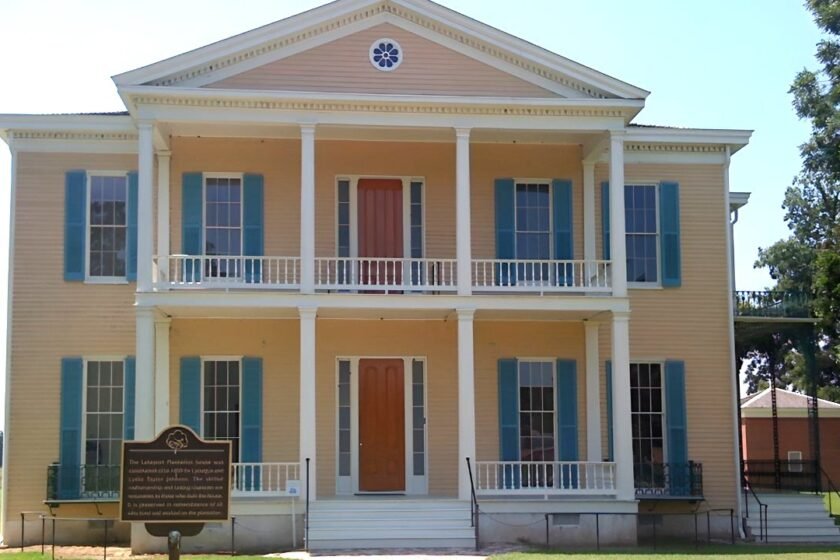

Scattered across Arkansas’ river valleys and backroads lie remnants of frontier plantations—places where history lingers in weathered wood, cotton fields, and family cemeteries. These estates once stood at the heart of the state’s early economy, built by ambition, agriculture, and the forced labor of enslaved people. Though time has changed their purpose or left some in ruin, these plantations still echo with stories of hardship, power, and perseverance. From stately homes to silent farmland, each site offers a glimpse into the complex past of the Natural State. Join us as we explore 10 frontier plantations that continue to whisper Arkansas’s layered legacy.
1. Dortch Plantation (1904) – Scott

The Dortch Plantation, established in 1904 near Scott, Arkansas, stands as a testament to post-Reconstruction Southern grandeur built atop older frontier farmland. Also known as Marlsgate, this opulent mansion was constructed by William Dortch on land his family had farmed since the 1830s, long before the Civil War reshaped the South. With its imposing columns, grand staircase, and formal gardens, the house reflects the wealth generated by cotton farming—but beneath its beauty lies a deeper story of enslaved labor and tenant farming that sustained the land for generations. Surrounded by oxbow lakes and flat delta fields, the plantation not only showcases Classical Revival architecture but also echoes with the voices of those who lived and worked there in both shadow and light.
2. Drennen-Scott House (1836)- Van Buren

Perched above the Arkansas River in Van Buren, the Drennen-Scott House dates back to 1836 and offers a vivid glimpse into frontier life at the edge of Indian Territory. Built by John Drennen, a prominent politician and Indian agent, the home was both a family residence and a hub of regional influence. Its walls bore witness to key moments in early Arkansas history, including the Trail of Tears, which passed just below its bluff. Enslaved people labored on the estate, maintaining the grounds and supporting the Drennen household—an often-overlooked aspect now honored in its interpretation. Carefully restored and now operated by the University of Arkansas – Fort Smith, the house invites visitors to explore its original furnishings, family letters, and creaking floorboards that echo with nearly two centuries of memory. It stands as one of the most intact frontier-era homes in the state.
3. Charlotte Teresa Plantation (2017) – Atkins

Nestled amidst a sprawling 6,000-tree pecan orchard in Atkins, Arkansas, the Charlotte Teresa Plantation is a testament to Southern charm and hospitality. Established by Billy and Charlotte Wilchman, this 13,000-square-foot manor, inspired by Louisiana’s Oak Alley Plantation, serves as both their residence and a welcoming bed-and-breakfast. Guests are treated to serene views of Petit Jean Mountain, luxurious accommodations, and the delightful aroma of homemade pecan fudge crafted on-site. Beyond offering a tranquil retreat, the plantation hosts quilting retreats, showcases Charlotte’s handcrafted quilts, and provides a unique agritourism experience, allowing visitors to immerse themselves in the rich tapestry of Arkansas’s pecan farming heritage.
4. Scott Plantation Settlement (1995) – Scott

The Scott Plantation Settlement in Scott, Arkansas, serves as a living museum preserving the region’s rich agricultural heritage. Spanning over eight acres of the historic Illallee Plantation, the site features twenty-five authentic structures, including an 1840s dogtrot log cabin, a hand-hewn cypress corncrib, a plantation “Big House,” a commissary, one-room schools, a doctor’s office, tenant houses, and a blacksmith shop. These buildings collectively depict plantation life from Arkansas’s early statehood through the early twentieth century. Visitors can explore these well-preserved structures and engage with exhibits that offer insights into the daily lives of both landowners and laborers, including enslaved individuals and tenant farmers.
5. Elms Plantation (1866) – Altheimer

The Elms Plantation, located near Altheimer, Arkansas, is a historic estate with roots stretching back to the post-Civil War era. Constructed in 1866 by Dr. Samuel Jordon Jones, the house exemplifies the Louisiana raised cottage architectural style, a rarity in Arkansas. The estate remained within the Jones family until the Great Depression, when it was acquired by Benjamin Joseph Altheimer, a prominent attorney from Chicago. Following Altheimer’s death in 1946, the property returned to the Jones family’s descendants and has since been transformed into The Elms Lodge, a premier destination for waterfowl hunting enthusiasts.
6. Land’s End Plantation (1925) – Scott

Nestled along the Arkansas River in Pulaski County, Land’s End Plantation is a striking example of 20th-century agricultural ambition built upon a foundation of Southern tradition. Established in 1925, this 5,000-acre estate centers around a grand Tudor Revival-style mansion designed by prominent architect John Parks Almand. Unlike many older antebellum plantations, Land’s End reflects a transitional period in Arkansas’s rural development—where mechanized farming began to rise, yet the echoes of plantation culture still loomed large. The property includes over 20 original outbuildings, including tenant houses, barns, and a cotton gin, all contributing to its listing on the National Register of Historic Places.
7. Ten Mile House (Early 1800s) – Little Rock

The Ten Mile House, located at 6915 Stagecoach Road in Little Rock, Arkansas, stands as a testament to early 19th-century architecture and regional history. Constructed between 1822 and 1835 by Archibald McHenry, the one-and-a-half-story brick residence exemplifies Federal-style design, characterized by its symmetrical facade, central entrance with sidelights and transom, and paired chimneys rising from parapet walls at each end. Strategically situated ten miles south of Little Rock along the historic Southwest Trail, the house served as a prominent stop for stagecoaches traveling between Missouri and Texas. In 1929, the Confederate Last Stand Monument was erected on the premises to commemorate the final resistance of Confederate forces in Arkansas.
8. Goodlett Gin Historic District (1883) – Phillips County

The Goodlett Gin, constructed in 1883 by David Goodlett near Ozan in Hempstead County, Arkansas, stands as a testament to the region’s rich cotton industry heritage. In 1975, it was added to the National Register of Historic Places. Between 1978 and 1980, the gin was relocated to Historic Washington State Park, where it now serves as a museum, offering visitors a glimpse into the agricultural practices of late 19th and early 20th-century Arkansas. The district, once a vital part of the local economy, reflects the innovative methods of cotton processing in its time. Today, it provides an educational experience on the evolution of farming technology and the economic significance of cotton to the state.
9. Judd Hill Plantation (1930) – Judd Hill

Rising from the fertile Delta soil of Poinsett County, Judd Hill Plantation embodies the legacy of early 20th-century cotton empires in Arkansas. Founded in 1930 by a businessman Orange Judd Hill, the plantation quickly grew into one of the region’s most influential agricultural hubs. At its heart stands the Judd Hill Cotton Gin, built around 1930—one of the few brick gins of its era—symbolizing both industrial progress and the enduring reliance on cotton as economic lifeblood. The plantation operated through the turbulence of the Depression and into the mechanized age, adapting while still rooted in land, labor, and legacy traditions.
10. Plantation Agriculture Museum (1985) -Scott

The Plantation Agriculture Museum, located in Scott, Arkansas, preserves the state’s rich cotton farming heritage. Housed in a former general store built in 1912, the museum features exhibits detailing the history of cotton cultivation, from planting and harvesting to ginning and seed storage. The museum offers live demonstrations of water pumping and cotton ginning, providing visitors with a hands-on understanding of historical agricultural practices. Established in 1985, it serves as Arkansas’s 47th state park, offering insights into the evolution of farming technologies and the cultural significance of cotton to the region.