
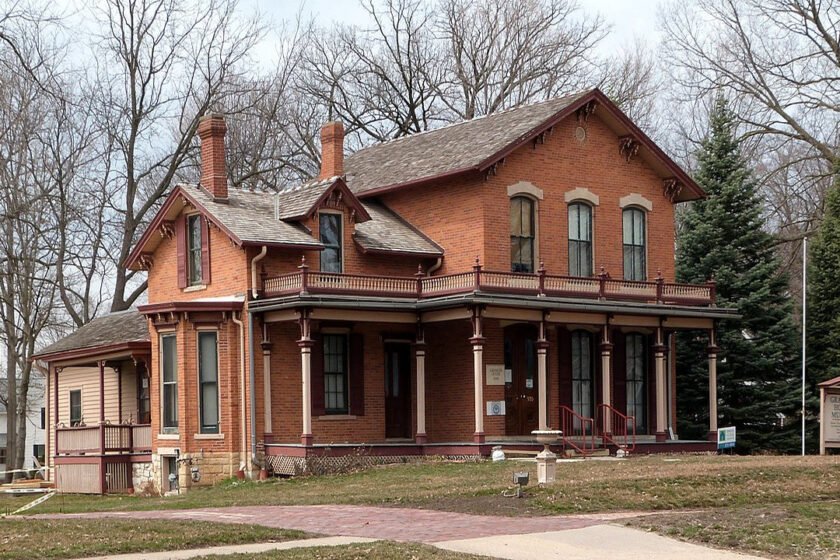

Iowa’s rolling landscape is dotted with historic farmhouses that chronicle America’s agricultural evolution. These architectural treasures stand as testaments to the pioneering spirit, changing farming practices, and cultural influences that shaped the heartland. Here are thirteen authentic Iowa farmhouses that continue to tell the story of America’s agricultural heritage.
1. Dibble House (1891) – Eldon

Made world-famous as the backdrop of Grant Wood’s iconic “American Gothic” painting, the Dibble House features distinctive Gothic Revival elements including its memorable pointed window. Built by Charles Dibble in 1881, this modest white frame house with its decorative bargeboard trim exemplifies how architectural styles from the East Coast were adapted to prairie environments. Though small by modern standards, the house represents the established farming operations that succeeded initial homesteading efforts in Iowa. Today, it’s preserved as the American Gothic House Center, allowing visitors to experience the setting that inspired Wood’s masterpiece depicting rural American life.
2. Terrace Hill (1869) – Des Moines

Built in 1869 as the centerpiece of Benjamin F. Allen’s 15-acre farm estate, Terrace Hill stands as one of Iowa’s grandest examples of Second Empire architecture adapted to an agricultural setting. This magnificent mansion, constructed at the then-astronomical cost of $250,000, features a distinctive mansard roof, ornate bracketed cornices, and an imposing central tower offering panoramic views of the surrounding farmland. The 18,000-square-foot home includes 20 rooms featuring black walnut woodwork, marble fireplaces, and elaborate plasterwork that showcased the wealth generated by Iowa’s booming agricultural economy. After passing through several owners, including Frederick M. Hubbell who maintained its agricultural connections, Terrace Hill was donated to the state in 1971.
3. Mathias Ham House (1856) – Dubuque

This impressive limestone and brick farmhouse stands as one of Iowa’s finest examples of Victorian architecture adapted to a working farm setting. Built by Mathias Ham, who made his fortune in lead mining and lumber before establishing a large agricultural operation, the house blends elegant Italianate and Gothic Revival elements with practical farming considerations. Notable features include a three-story tower, ornate wraparound porch, and fifteen rooms with twelve-foot ceilings. The property’s evolution from a self-sufficient pioneer farm to a diversified agricultural business is evident in its expanding structure and specialized outbuildings. Now preserved as a historic site, the Ham House demonstrates how Iowa’s agricultural prosperity supported increasingly refined rural living.
4. Jordan House (1850) – West Des Moines

Built in two phases between 1850 and 1870 by James Cunningham Jordan, this stately white clapboard farmhouse combines Victorian and Italianate elements while serving as the centerpiece of a 700-acre cattle operation. The house features distinctive bracketed eaves, a wraparound porch, and large windows topped with decorative lintels. Beyond its architectural significance, the Jordan House holds historical importance as a documented Underground Railroad station where Jordan, an abolitionist, sheltered freedom seekers. The property showcases how established Iowa farms often served multiple roles in their communities, combining agricultural production with civic leadership. Today, it operates as a museum illustrating both farming heritage and Iowa’s role in the anti-slavery movement.
5. Salisbury House (1885) – Des Moines

Though later converted to a city residence, this splendid farmhouse was originally built as the center of a large agricultural operation by Frederick Salisbury. The Romanesque Revival structure, constructed of local limestone, features a distinctive turret, decorative stonework, and imposing proportions that reflect the prosperity of established Iowa farms in the late 19th century. The house’s fifteen rooms include specialized spaces for both agricultural management and formal entertaining, demonstrating how successful farm families balanced practical needs with social aspirations. The property’s transition from agricultural estate to urban mansion parallels Iowa’s economic diversification beyond farming. Now preserved as a cultural center, the Salisbury House illustrates how agricultural wealth contributed to Iowa’s architectural heritage and cultural development.
6. William Larrabee House “Montauk” (1874) – Clermont

Though larger than typical farmhouses, this impressive mansion was the centerpiece of Governor William Larrabee’s working farm operation. The Italianate brick structure with its distinctive tower, bracketed eaves, and elaborate trim exemplifies how Iowa’s agricultural prosperity supported increasing refinement in rural architecture. Larrabee, who served as Iowa’s 12th governor, maintained his connection to agriculture while entering politics, demonstrating the influence farmers wielded in early Iowa governance. The house features unusually advanced amenities for its time, including indoor plumbing and central heating. Now preserved as a historic site with original furnishings, Montauk illustrates how successful farming operations provided the foundation for political and social advancement in Iowa’s developing society.
7. Gebhard Farmhouse (1886) – Oskaloosa

This beautifully preserved brick farmhouse represents the prosperity achieved by German immigrants who applied Old World farming techniques to Iowa’s fertile soil. Built by the Gebhard family after two decades of successful farming, the two-story structure features locally produced bricks, symmetrical façade, and decorative wooden porches characteristic of the era. The house’s transitional architectural style combines practical farmhouse layout with Victorian decorative elements including ornate woodwork and transom windows. The surrounding property still maintains historic outbuildings including a distinctive Pennsylvania-style bank barn and summer kitchen, presenting a complete picture of late 19th-century farm operations. Now maintained as a heritage site, the Gebhard Farmhouse demonstrates how ethnic traditions influenced Iowa’s agricultural development.
8. Parker Historical Farmstead (1860) – Urbandale

This remarkably intact farm complex centers around a classic white clapboard farmhouse built by pioneer settlers Ambrose and Dorcas Parker. The modest two-story structure with its central gable and symmetrical design represents the practical yet dignified homes built by established farmers after their initial settlement period. Unlike more elaborate Victorian farmhouses, the Parker home emphasizes function over decoration while still incorporating refinements like large multi-pane windows and decorative porch details. The property’s exceptional value comes from its complete collection of original outbuildings, arranged in the traditional Iowa farm layout and demonstrating how family farms operated as self-contained units. Now preserved as a living history museum, the Parker Farmstead offers visitors an authentic glimpse into daily agricultural life in Iowa during the Civil War era.
9. Dow House (1870) – Dow City

This distinctive brick farmhouse showcases the prosperity achieved by Dow City’s founder, Simon Dow, whose agricultural ventures laid the foundation for community development. The imposing two-story structure features elaborate brick detailing, tall windows with decorative hoods, and a broad covered porch suitable for observing farm operations. The house combines practical farming requirements with aspirational architectural elements reflecting the family’s elevated social position as community founders and agricultural innovators. Interior features include unusually spacious rooms, advanced heating systems, and formal entertaining spaces rarely found in typical farmhouses. The property’s evolution from frontier farm to established agricultural business parallels Iowa’s transformation from wilderness to cultivated prairie and illustrates how successful farmers became community leaders.
10. Wilder Farmhouse (1876) – Mason City

Though more modest than some Victorian farmhouses, this well-preserved structure offers insights into everyday farm life during Iowa’s agricultural expansion period. Built by Franklin Wilder, who transformed 160 acres of prairie into a productive diversified farm, the two-story frame house features a practical layout with Greek Revival influences evident in its proportions and detailing. The house represents the middle range of farm prosperity—beyond pioneer cabins but more restrained than elaborate Victorian showplaces. Notable features include locally sourced materials, a functional summer kitchen addition, and practical built-in storage systems designed for farm life. Now maintained as a historic site, the Wilder Farmhouse demonstrates how architectural styles were adapted to meet the practical demands of agricultural living while providing comfort for hardworking farm families.
11. Living History Farms 1900 Farm House – Urbandale

This meticulously reconstructed farmhouse at Living History Farms represents the typical home of prosperous Iowa farmers at the turn of the 20th century. Based on architectural patterns common throughout central Iowa, the large two-story structure features Queen Anne influences including a wraparound porch, bay windows, and modest decorative trim. The house’s interior showcases the technological transitions occurring in rural America, with spaces for both traditional farmhouse activities and newer conveniences becoming available through mail-order catalogs and improved transportation. While constructed as an educational exhibit rather than an original structure, the 1900 Farm House accurately depicts authentic building techniques and typical farm layouts documented through extensive historical research, making it a valuable resource for understanding Iowa’s agricultural heritage.
12. Usher Farmhouse (1865) – Fort Dodge

This handsome farmhouse built by pioneer farmer James Usher represents the success achieved by early settlers who transformed raw prairie into productive farmland. The brick structure with limestone foundation features a symmetrical façade, double-hung windows with decorative lintels, and a functional front porch—all hallmarks of established farm prosperity beyond the initial settlement period. Inside, the house combines practical farming needs with modest refinements including built-in cabinetry, formal parlor spaces, and specialized storage areas for farm-produced goods. The property’s evolution through multiple agricultural eras is evident in adaptations and additions made as farming practices changed. Now preserved as a county historical site, the Usher Farmhouse demonstrates how Iowa’s agricultural development progressed from subsistence farming to commercial production through generations of family stewardship.
13. Abbie Gardner Sharp Cabin (1856) – Arnolds Park

Though smaller than later farmhouses, this frontier log cabin represents the earliest permanent European-American agricultural settlements in northwestern Iowa. Built by Rowland Gardner as the centerpiece of a developing farm and mill operation, the cabin witnessed the dramatic conflicts between settlers and Native Americans during the territorial period. Constructed of hand-hewn logs with dovetailed corners, the cabin’s sturdy construction has enabled it to survive as one of Iowa’s oldest remaining farm structures. While modest in size, the building incorporates surprising refinements including glass windows, wooden flooring, and a sleeping loft—luxuries on the agricultural frontier. After surviving the Spirit Lake Massacre of 1857, the cabin was later preserved by Gardner’s daughter Abbie. Now maintained as a historic site, it provides valuable insights into Iowa’s earliest agricultural settlement period and the challenging conditions faced by pioneer farm families.