
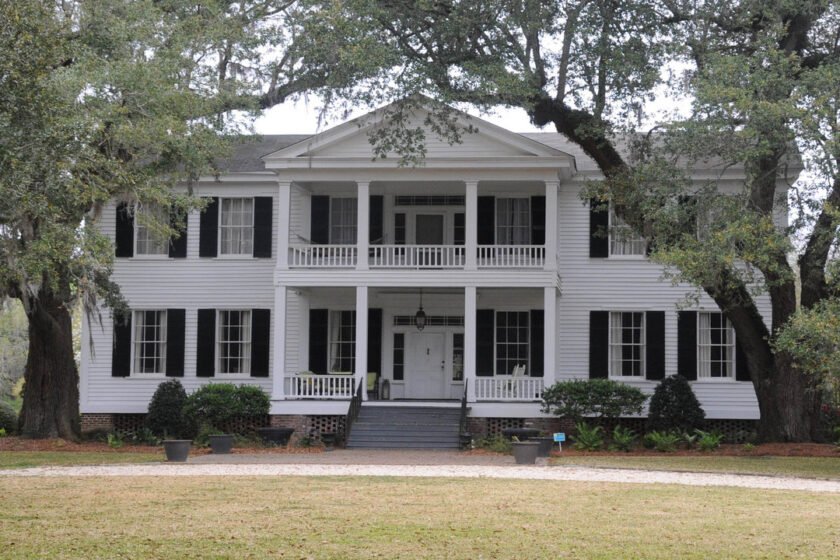

Before the Civil War reshaped the American South, antebellum homes across South Carolina stood as imposing symbols of wealth, status, and agrarian power. Built on the backs of enslaved labourers, these homes were often designed with grandeur in mind, towering columns, sweeping verandas, and finely detailed woodwork. But time is not always kind to such splendour. Some of these homes have been lovingly preserved, others left to decay, and a few lost entirely to neglect or development. In this piece, we explore 15 antebellum homes that withered in time, each one telling a story of beauty, loss, and the complex legacy of South Carolina’s past.
1. Boone Hall (1843) – Mount Pleasant

Boone Hall once stood as a powerful symbol of Lowcountry wealth, its avenue of oaks stretching like a green cathedral toward a grand façade. Built in the early 19th century, the home oversaw cotton and brick production, worked by enslaved laborers whose lives built its legacy. Time, however, has not been kind. Though its presence still lingers, the surrounding landscape bears the marks of erosion—decay tucked behind beauty, and echoes of lives long faded. Boone Hall’s grandeur is now a ghost of itself, a shell softened by moss, shadow, and the hush of history unspoken.
2. Borough House Plantation (1758) – Stateburg

The Borough House Plantation was a marvel in its day, built using tabby concrete and known for its unique architectural strength. It watched over miles of fertile land and carried the weight of generations who passed through its halls. Today, the plantation lies in stillness. Its columns stand cracked and weary, the once-bold walls now chipped and faded. Wind weaves through empty corridors, and ivy coils through forgotten doorways. What remains is not grandeur, but gravity—an estate quietly bowing beneath the burden of time and memory.
3. Brick House Ruins (1725) – Edisto Island

What’s left of the Brick House on Edisto Island speaks louder than walls ever could. Built in the early 1700s and later consumed by fire, its scorched skeleton rises from the earth like a monument to loss. The tall brick chimneys and fragmented walls wear the blackened scars of destruction and neglect. Once home to a family of plantation owners, it now shelters only moss and stillness. Brick House didn’t simply crumble—it was swallowed by the elements and forgotten seasons. Its haunting profile is a solemn reminder that not all history survives in full.
4. Drayton Hall (1738) – Charleston

Drayton Hall, one of the oldest preserved plantation houses in the country, stood untouched by the flames of war—but not by time. Its Palladian architecture and symmetrical design reflected the height of colonial sophistication. Yet over the decades, the paint peeled, the wood groaned, and the silence grew heavier. No modern comforts were added, no new wings built—just slow, silent aging. The house became a relic, frozen in its own dust, its walls sagging beneath centuries of history. Drayton Hall didn’t fall—it simply stood still until the world moved on without it.
5. Fort Hill (1803) – Clemson

Tucked in the Upstate hills, Fort Hill was once the proud home of John C. Calhoun, a controversial figure in American history. The plantation house reflected early 19th-century prosperity, with broad porches and commanding views. As years turned, Fort Hill aged quietly. The surrounding grounds grew wild, shutters hung crooked, and its heart slowed. The walls that once echoed with debate and power now settle into silence. The grandeur has faded, but its presence lingers—faded, weathered, and worn by the same history it once helped shape.
6. Hampton Plantation (1735) – McClellanville

Hidden in the lowcountry woods, Hampton Plantation once thrived under the weight of rice and aristocracy. Built in the 1730s and expanded in the 1790s, it stood as a testament to Georgian refinement. But time knows no titles. The grand house, once echoing with elite conversation and servant footsteps, slowly slipped into stillness. Shutters warped, floorboards buckled, and vines crept up columns once scrubbed clean. Beneath the canopy of live oaks, Hampton now slumbers—its legacy softened by layers of dust and silence, a monument not to glory, but to surrender.
7. Harrietta Plantation (1807) – McClellanville

Tucked between marshland and pine, Harrietta Plantation once oversaw fields of rice that shimmered in the Southern sun. Built in 1807, its charm was in its balance—both architectural and agricultural. But with the passing decades, Harrietta grew quiet. Storms beat the roof, and time broke the symmetry it once boasted. The surrounding wilderness slowly crept forward, cloaking it in moss and mildew. Its chimneys lean now, and the paint flakes like old parchment. Harrietta didn’t collapse in a single moment—it dimmed slowly, gently forgotten by a world too fast to look back.
8. Hobcaw Barony (1763) – Georgetown

Once a colonial land grant turned prosperous rice empire, Hobcaw Barony became a patchwork of plantation homes. Though the estate endured well into the 20th century, its antebellum heart faded beneath layers of change. Time washed over the original house, eroding its edges and haunting its halls. Trees took root where bricks fell loose, and the surrounding fields—once carved by enslaved hands—returned to swamp and shadow. Hobcaw whispers its story through broken shutters and empty stairwells, where the past clings to the walls like the Spanish moss overhead.
9. Hopesewee Plantation (1735) – Georgetown

Hopsewee was born before the nation itself, rising in 1735 from the banks of the Santee River. It was the birthplace of Thomas Lynch Jr., a signer of the Declaration of Independence, but its deeper story was written by the enslaved who built and maintained it. Time, too, left its mark—weather carving into wood, storms loosening shingles, and years dimming the grandeur that once defined it. Though the framework endures, the spirit of the place has softened. Hopsewee lingers now as a shadow—its strength worn thin by the quiet erosion of memory.
10. Magnolia Plantation and Gardens (1676) – Charleston

Magnolia, with its sweeping gardens and mirrored ponds, once dazzled with beauty built on the backs of the enslaved. The house, though romantic in appearance, bears the scars of age beneath its surface. Founded in the 1670s and rebuilt after the Civil War, its walls now sag slightly, and time has tugged at its charm. The gardens remain—but the house, the soul of the estate, has withered beneath layers of weather and years. What remains is a fragile blend of beauty and decay, like a memory that smiles even as it fades.
11. Mansfield Plantation (1718) – Georgetown

Mansfield Plantation once stretched across the Waccamaw River, a rice empire sculpted by enslaved labor. The home, built in 1718, stood in hushed elegance behind a veil of cypress and Spanish moss. But like so many others, its prominence faded as the decades passed. The iron gates rusted. Floorboards warped beneath the weight of years. The fields grew wild, overtaking what had been so carefully ordered. Today, Mansfield stands not in majesty, but in memory—its quiet decay a testament to time’s refusal to let even the most storied legacies remain untouched.
12. Marshlands (1810) – Beaufort

Marshlands sat proudly on Lady’s Island, a Federal-style home, raised in 1810, amid tidal creeks and palmetto breezes. It once housed military officers and Southern elites, its tall windows offering panoramic views of the surrounding waters. But tides change. The paint began to peel like parchment, the air inside thickened with damp, and the structure itself slouched under the weight of the past. Though it was moved in an attempt to preserve it, Marshlands could not escape time’s quiet undoing. It remains, half-forgotten, where echoes now outnumber voices.
13. McLeod Plantation (1851) – James Island

McLeod Plantation’s story is etched in brick, blood, and Spanish moss. Established in 1851, it was a cotton plantation that played silent witness to both bondage and battle. Time, however, took its toll. The house, once stark in white, grew dulled by salt air and overgrowth. Wooden beams sagged, plaster cracked, and glass dimmed with dust. The beauty of McLeod is no longer in its form—but in its resilience, as a relic withstanding the slow pull of ruin. It is less a home now than a memory wearing a roof.
14. Middleburg Plantation (1699) – Huger

Middleburg Plantation, the oldest wooden home in South Carolina, was built in 1699 along the Cooper River. It once commanded respect with its refined symmetry and imposing stature. But centuries do not pass without a toll. The structure has endured war, neglect, storms, and silence. Its frame creaks beneath invisible burdens, and every board whispers the sound of time unraveling. What was once regal is now weary—surviving more from stubbornness than strength. Middleburg withered not with violence, but with the slow sigh of forgotten history.
15. Oakland Plantation (1745) – Mount Pleasant

Oakland Plantation, raised in the 18th century, once formed the heart of a thriving agricultural operation near the coast. Surrounded by rice fields and maritime forests, the estate carried itself with quiet authority. But nature reclaimed its claim. The home aged in the shadow of its own past—porches sagging, brick stairs crumbling, and the grounds thick with the green hush of abandonment. No wrecking ball came. No fire consumed it. Oakland simply faded, bit by bit, as if the land itself wanted the story buried.