
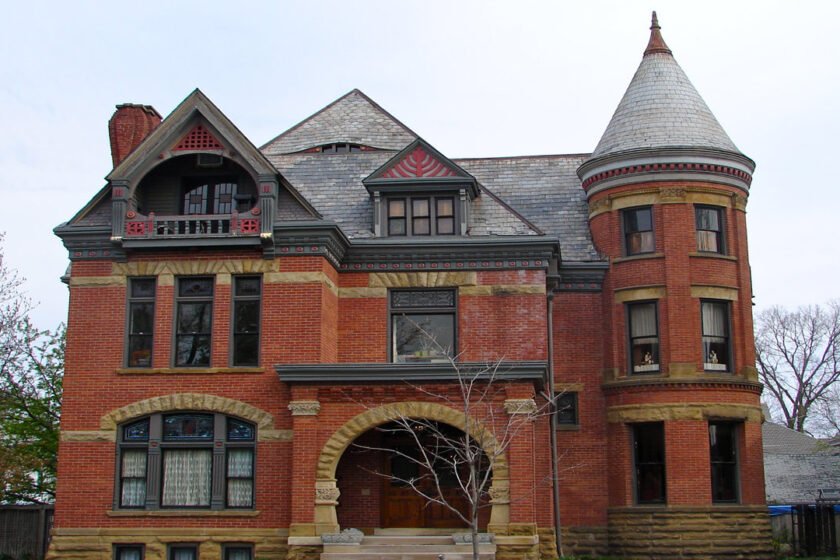

Indiana’s rolling farmland once nurtured more than crops—it held the stories of families, pioneers, and craftsmanship rooted deep in the heartland. Farmhouse manors across the state once stood as proud pillars of agricultural life, architectural charm, and generational legacy. Some were grand estates, others modest homesteads, but each carried a spirit of the frontier. While many have vanished or faded into disrepair, their memory lingers—etched in weathered brick, forgotten gardens, and community lore. These fifteen homes represent the passing of an era, each lost to time, but not to history.
1. Morris–Butler House (1864, Indianapolis)

Built during the Civil War, the Morris–Butler House is a fine example of Second Empire architecture. Once preserved as a museum, its detailed cornices and mansard roof reflected Victorian elegance in the heart of Indianapolis. Though the house has been repurposed for events and programs, its days as a public museum are over. It remains a quiet echo of Indiana Landmarks’ earliest preservation work—its rooms no longer toured, but still carrying the legacy of its storied past.
2. Smith Farm (1928, Plainfield)

The Tudor Revival-style Smith Farm, constructed in 1928, once graced Plainfield’s landscape with its distinctive gables and rustic elegance. Despite being recognized on the National Register, development pressure cast a shadow over the property. Its barns and house stood as a testament to early 20th-century design in Indiana farm life. Delisted in 2023, the site has since disappeared beneath progress, leaving behind only memories of its pastoral charm.
3. Thomas Lanier Farmhouse (1832, Madison)

Thomas Lanier, a wealthy merchant and civic leader, built this Federal-style farmhouse in the early 1830s as part of a working estate near the Ohio River. The home’s elegant proportions and proximity to the Lanier Mansion (his brother’s home) marked it as a symbol of early prosperity. After decades of vacancy, it was demolished in the 1970s. It’s remembered today as part of the region’s merchant class history.
4. Reynolds House (1870, Monticello)

Built in 1870, the Reynolds House was a stately Italianate farmhouse that belonged to the influential Reynolds family, who helped develop local railroads and agriculture. With its bracketed cornices and tall windows, it exemplified rural sophistication in Indiana. Though the house once hosted community gatherings and political figures, it fell into disrepair and was ultimately lost to fire in the early 2000s. It lives on in county records and family histories as a landmark of Monticello’s golden era.
5. Lenhart Farmhouse (1830, Adams County)

A classic Federal I-house with Greek Revival touches, the Lenhart Farmhouse stood as a proud example of evolving rural architecture. Over the decades, it adapted to changing needs, witnessing generations of family life and shifting agricultural practices. Though altered, its structure bore the timeless lines and rural elegance that defined Indiana’s farmhouse heritage. It now serves as a faded memory of resilience and style on the frontier.
6. Huddleston Farmhouse (1838, Cambridge City)

Once a welcome refuge along the National Road, the Huddleston Farmhouse was built in 1838 as an inn and family residence. Its Federal style and practical layout made it a symbol of hospitality and frontier spirit. Preserved by Indiana Landmarks, it no longer bustles with guests or daily chores, but remains an architectural bookmark in the story of Indiana’s westward growth.
7. Asahel Stone Mansion (1872, Winchester)

Long abandoned, the Asahel Stone Mansion is known more today for its ghost stories than its once-proud design. A grand home in its time, it fell into neglect, becoming a subject of paranormal intrigue. Its empty halls and boarded windows hide a past filled with community status and local influence. Today, it stands as a haunting symbol of forgotten grandeur.
8. Sage-Robinson-Nagel House (1868, Terre Haute)

Built in 1868, this Italianate brick home was a showcase of mid-19th-century elegance with bay windows, bracketed eaves, and a decorative front porch. Later known as the Historical Museum of the Wabash Valley, it served the community before its decline. Though listed on the National Register, the home now stands quietly in Farrington’s Grove—its role in local heritage slipping ever closer to obscurity.
9. Birdsell Mansion (1898, South Bend)

Once a jewel in South Bend’s architectural crown, the Birdsell Mansion reflected the industrial wealth of its owner, J.B. Birdsell. Built in 1898 with lavish details, it has stood vacant for more than a decade, slowly deteriorating under time and weather. Despite its former glory, neglect has clouded its future. The mansion remains a reminder of the fragility of heritage when stewardship fades.
10. Freeman-Durham House (1849, Monroe County)

Constructed of limestone quarried nearby, the Freeman-Durham House featured simple Greek Revival symmetry and thick walls suited for frontier living. Originally part of a 200-acre working farm, the home changed hands through several families before falling vacant in the 1980s. It was lost to structural decay and later demolished, but old photographs and local archives preserve its story as one of Monroe County’s earliest rural dwellings.
11. St. Joseph County Infirmary (1906, South Bend)

Built in 1906, this Classical Revival building once served the elderly and indigent. With its imposing columns and institutional charm, it reflected early 20th-century ideals of social care. Though listed on the National Register, it was closed and is slated for demolition in 2024. The infirmary’s story illustrates how even civic institutions tied to farm culture can be lost to time and policy.
12. David Brown House (1825, Rising Sun)

Dating back to around 1825, the David Brown House is a rare two-story log home in Indiana. It offered shelter to one of the region’s early families and stands as a simple yet striking example of pioneer resilience. Though still privately owned, its condition and limited access keep it tucked away from public view—a nearly forgotten link to Indiana’s earliest settlers.
13. Grouseland (1804, Vincennes)

Completed in 1804 by William Henry Harrison, Grouseland is one of Indiana’s oldest and most important Federal-style homes. Though preserved as a museum, its former role as a governor’s residence and frontier outpost is often overlooked. The home represents political ambition, frontier diplomacy, and genteel living in an untamed land—elements that make it a foundational chapter in Indiana’s domestic past.
14. Rose Hill Farmstead (1827, Knox County)

This Federal-style brick I-house stood proudly for nearly two centuries and once served as a safe stop on the Underground Railroad. Built in 1827, it bore witness to the shifting tides of American freedom and agriculture. Sadly, Rose Hill was demolished in 2012 after being removed from the National Register. Its absence marks not only the loss of a home but a vital thread in Indiana’s civil rights and farming history.
15. The Barns at Nappanee (1873, Nappanee)

Once known as Amish Acres, this historic farmstead has undergone many changes. Originally built in the mid-19th century, it became a cultural attraction before falling into operational decline. Its timber-framed barns and farmhouse remain, but the vibrant rhythms of Amish farm life are no longer heard. The site stands as a shadow of what it once was—a cultural hub turned quiet landmark.