
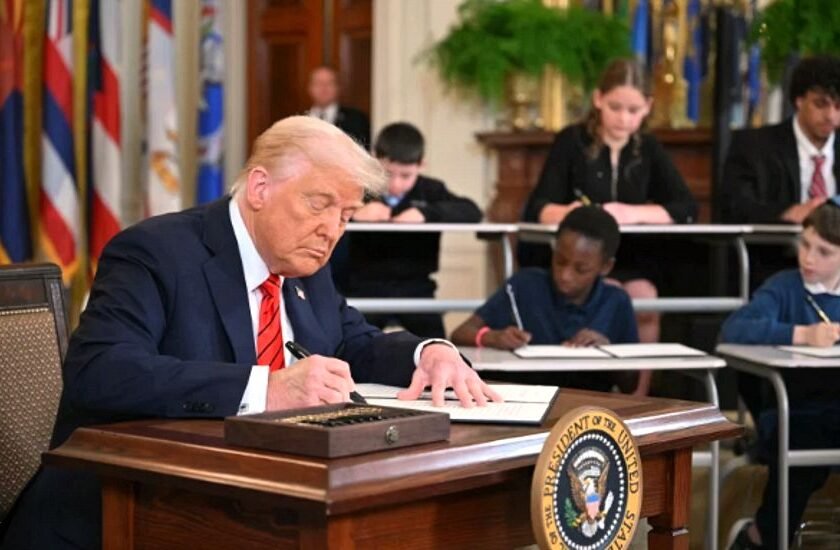

In a bold escalation of his campaign against U.S. universities, President Donald Trump is preparing to sign an executive order requiring colleges to disclose their student admissions data to the federal government. The move comes as part of a broader crackdown on diversity, equity, and inclusion (DEI) initiatives, programs that Trump has labeled discriminatory. The order has reignited fierce debates over academic freedom, federal overreach, and the future of race-conscious admissions.
Push for Transparency
White House Press Secretary Karoline Leavitt confirmed the impending order via a repost on X (formerly Twitter), citing an article by right-wing outlet The Daily Caller. The directive will compel universities to submit detailed admissions information to federal authorities, a major step in Trump’s long-running effort to reshape higher education.
Trump and other Republicans have accused elite academic institutions of ideological bias and “reverse discrimination,” aiming to force open what they view as a secretive admissions process.
Vance Slams University Bias
Earlier in June, Vice President JD Vance also accused U.S. universities of racially discriminating against white and Asian students, claiming it violates civil rights laws. He also criticized universities for being politically biased and having bloated bureaucracies that block innovation. His comments come as debates over affirmative action continue, especially after the Supreme Court banned race-based admissions in 2023. Some Asian American leaders argue their identity is being misused to fight diversity policies.
Dismantling DEI Policies
The new move is part of a broader purge. On January 20, his first day in office for a second term, Trump signed an executive order titled “Ending Radical And Wasteful Government DEI Programs And Preferencing.” It repealed President Joe Biden’s earlier efforts to promote racial equity and declared diversity initiatives to be “illegal and immoral.”
“Federal employment practices, including Federal employee performance reviews, shall reward individual initiative, skills, performance, and hard work and shall not under any circumstances consider DEI,” the order states.
Corporations Follow Trump’s Lead
Major U.S. corporations have already responded to the administration’s tone. Retail giant Target and automaker Ford have both scaled back DEI programming, appearing to align with Trump’s platform. Critics, however, argue that the president’s actions may overstep constitutional boundaries, infringing on the free speech and private policies of businesses and educational institutions.
Without proactive diversity support, they warn, institutions risk reinforcing long-standing disparities in race, gender, and access to power.
Affirmative Action Overturned
Trump’s war on diversity programs gained momentum in 2023, when the conservative-majority U.S. Supreme Court struck down affirmative action in college admissions. The decision ruled that considering race in student selection violated the Constitution’s Fourteenth Amendment, effectively ending decades of precedent.
Trump capitalized on the moment, doubling down on his message: “Hardworking Americans who deserve a shot at the American Dream should not be stigmatized, demeaned, or shut out of opportunities because of their race or sex,” his January 21 executive order read.
Funding Pressure on Universities
Trump has also used federal funding as leverage. Billions of dollars in grants and contracts have been pulled from institutions like Columbia University, Harvard University, and UCLA, with conditions placed on restoring them.
Columbia became the first major university to comply, agreeing to reassess its admissions policies and form an advisory group to “analyze recent trends in enrollment” and “report to the President.”
Deals Struck, Investigations Dropped
In several cases, universities have accepted the Trump administration’s terms to avoid prolonged legal scrutiny. Brown University recently agreed to a $50 million deal to support workforce development in exchange for the end of federal investigations and continued access to funding.
As part of that agreement, Brown pledged to uphold “merit-based admissions policies” and eliminate any racial considerations. “No proxy for racial admission will be tolerated,” the agreement reads. “Brown may not use personal statements, diversity narratives, or any applicant reference to racial identity as a means to introduce or justify discrimination.”
Harvard Pushes Back
Not all institutions have complied. Harvard University, the country’s oldest and one of its most prestigious, rejected Trump’s proposed deal. In April, Harvard President Alan Garber refused to undergo a “comprehensive audit” of the university’s hiring and admissions processes.
“No government, regardless of which party is in power, should dictate what private universities can teach, whom they can admit and hire, and which areas of study and inquiry they can pursue,” Garber stated. The standoff continues as Harvard resists what it sees as an attack on academic independence.