
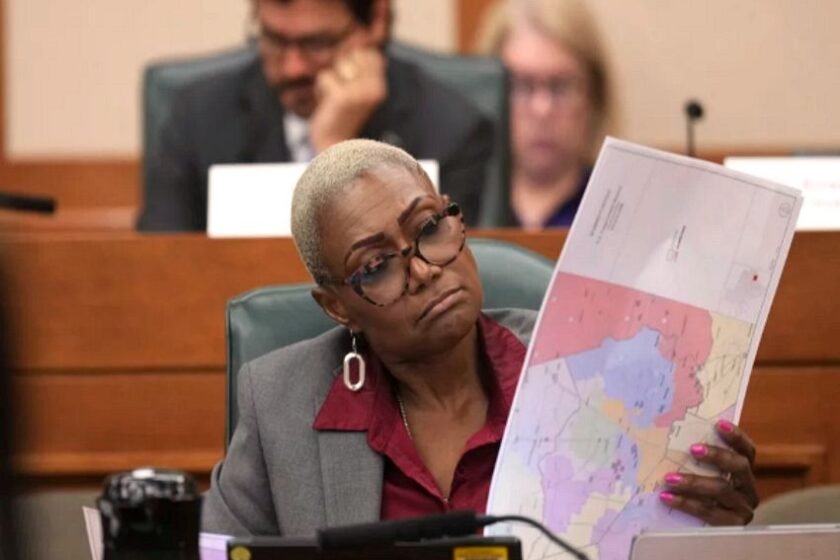

In a late-night vote on Wednesday, the Texas House approved a new congressional redistricting map that could give Republicans up to five more U.S. House seats. The measure, passed 88–52, has sparked fierce debate, with Republicans calling it a constitutional exercise of political power and Democrats denouncing it as racial gerrymandering. The final decision now shifts focus to expected legal battles.
Partisan Map Drawn
The map was introduced by Rep. Todd Hunter, a Republican from Corpus Christi, and crafted with help from law firm Butler Snow. Hunter was direct about the intent: “The straightforward goal of this map is to improve Republican political performance.” He cited the U.S. Supreme Court’s 2019 ruling in Rucho v. Common Cause, which declared federal courts could not strike down partisan gerrymanders.
Democratic Pushback
Democrats sharply opposed the measure, labeling it discriminatory toward minority voters. They argued that Black and Hispanic communities were deliberately divided across districts to dilute their influence. Multiple Democratic lawmakers attempted to add amendments that would force compliance with the Voting Rights Act, delay implementation until court challenges conclude, or hand redistricting power to an independent commission. All those efforts failed.
Civil Rights Concerns
Voting rights advocates and civil rights groups have already signaled their intent to challenge the map in court. They maintain the plan violates protections under federal law. During Wednesday’s session, Rep. Gene Wu, a Houston Democrat, called the legislation “an insult to democracy” and said it was designed to “silence the voices of minority Texans.”
Protests at the Capitol
Hundreds of demonstrators gathered inside the Texas Capitol throughout the day, chanting against the bill and holding signs demanding fair representation. A large banner draped across the rotunda read: “END GERRYMANDERING SAVE DEMOCRACY.” The protests echoed through the building as lawmakers debated and eventually approved the map.
Targeted Democratic Seats
The new districts could flip several Democratic strongholds. Among them are Houston’s TX-9, represented by Rep. Al Green, and TX-28, held by Rep. Henry Cuellar of Laredo. Analysts say the new boundaries could drastically change the electoral landscape heading into the 2026 midterms, strengthening the GOP’s hold on the Texas delegation in Washington.
What Comes Next
With the Texas Senate expected to advance the map in the coming weeks, attention is turning toward the courts. Democrats and advocacy groups are preparing lawsuits that could determine whether the map stands in time for the 2026 elections. Still, Republicans insist the process was lawful. As Hunter concluded, “This is about exercising the constitutional right to draw districts.”