
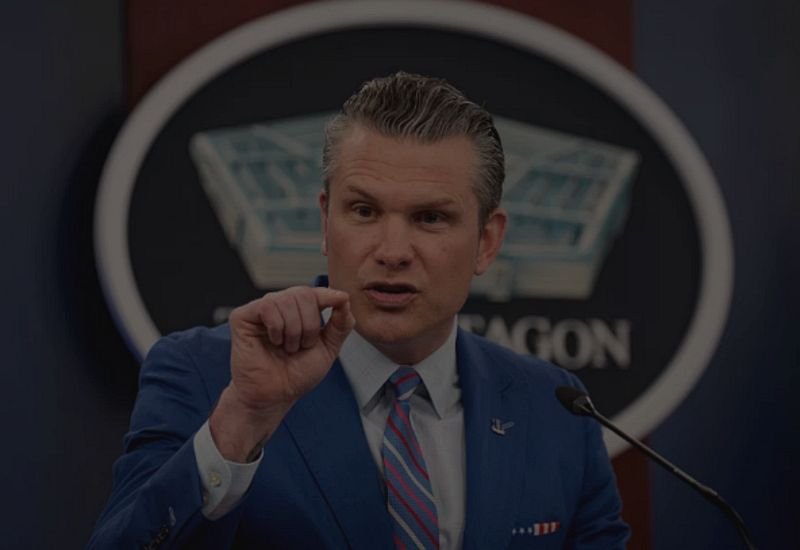
In a surprising turn at the Pentagon, US Defense Secretary Pete Hegseth has dismissed Navy Chief of Staff Jon Harrison, a key architect behind major structural changes in the Navy’s budgeting and policy offices. The abrupt firing, confirmed Friday, deepens internal divisions as the Trump administration continues to overhaul military leadership. Harrison’s removal follows months of tension over control within the Navy and comes just days after a new undersecretary was confirmed.
Sudden Firing Stuns Pentagon
Pete Hegseth abruptly removed Jon Harrison from his post as Navy Chief of Staff on Friday, ending a brief but turbulent tenure. Harrison, who took office in January, was instrumental in implementing sweeping administrative reforms that altered how the Navy’s policy and budgeting divisions operated. The Pentagon confirmed his dismissal in a statement to Politico, saying, “He will no longer serve as Chief of Staff to the Secretary of the Navy. We are grateful for his service to the Department.” The announcement sent shockwaves through military ranks already unsettled by rapid leadership changes under Hegseth.
Harrison’s Role in Navy Overhaul
Harrison, a close ally of Navy Secretary John Phelan, had been deeply involved in efforts to reshape the Navy’s internal hierarchy. Both men reportedly sought to reduce the influence of the Navy undersecretary — a role traditionally responsible for managing budgets and long-term planning. Their push for tighter administrative control drew criticism from within the department, as many viewed it as consolidating authority under political appointees rather than career officers.
New Undersecretary Confirmation
The dismissal came just days after Hung Cao, a former naval officer and Republican Senate candidate, was confirmed as Navy undersecretary. According to Politico, Harrison and Phelan had previously reassigned several senior aides who were meant to help Cao transition into his position. The move was allegedly designed to limit the new undersecretary’s power. With Cao now officially in place, Harrison’s departure signals a potential shift in the Navy’s balance of authority.
Months of Military Upheaval
Hegseth’s decision continues a pattern of sweeping changes within the US military. Since taking office, he and former President Donald Trump have fired more than half a dozen top generals, including the military’s only two female four-star officers. Earlier this year, Hegseth also dismissed Air Force General CQ Brown Jr., the chair of the Joint Chiefs of Staff and only the second Black man ever to hold that role. In May, he ordered a 20% reduction in the number of four-star generals and admirals, a move that drew heavy criticism from defense analysts and veterans’ groups.
Controversial ‘Anti-Woke’ Agenda
Hegseth, a former Fox News host and a long-time critic of diversity initiatives, has publicly attacked what he calls the military’s “woke culture.” In a recent speech to top officers, he claimed the Department of Defense had become “the woke department,” vowing to restore what he described as “traditional military values.” The address was met with outrage among veterans and current service members, many calling his remarks “insulting” and divisive at a time when morale is already strained.
Reactions From Veterans
Veterans’ groups have condemned Hegseth’s rhetoric and rapid firings, calling them politically motivated and damaging to the institution’s credibility. “He’s undermining experienced leadership in the name of politics,” one retired officer told Politico. Critics argue that Hegseth’s approach prioritizes ideology over merit and risks destabilizing the armed forces during a volatile global period. The Pentagon, however, maintains that the personnel changes are part of a broader “restructuring for efficiency.”
Growing Rift in Military Leadership
The firing of Jon Harrison underscores a deeper power struggle within the Pentagon as Trump’s team continues to assert control over senior military appointments. With key allies like Phelan and Hegseth driving policy, and new figures like Hung Cao entering leadership, the Navy’s direction remains uncertain. For now, the administration appears determined to centralize authority, even if it means sacrificing seasoned leadership in the process.