
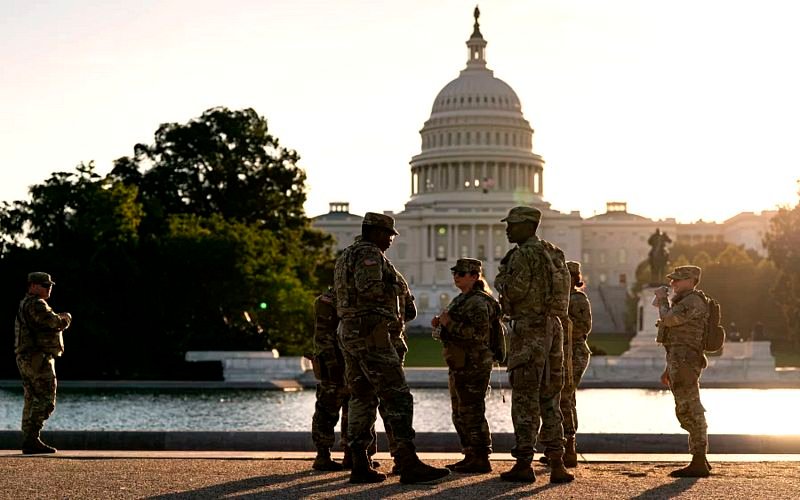
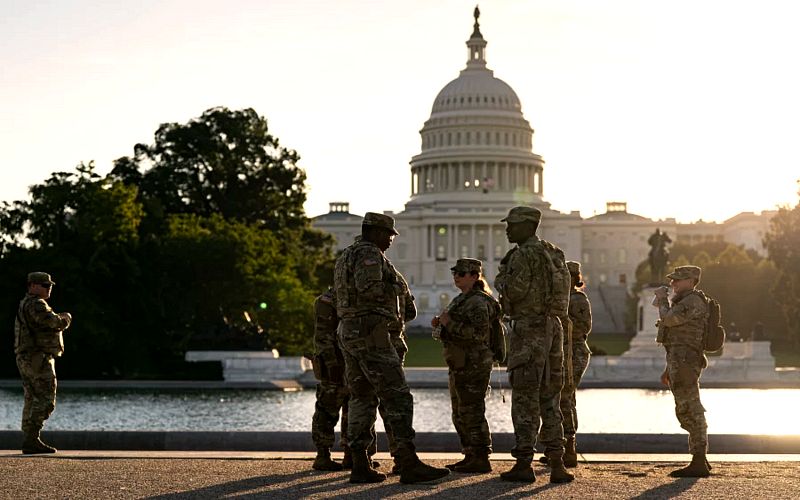
A federal appeals court has ruled that National Guard troops in Illinois may remain under federal control but cannot be deployed while the legal battle between the Trump administration and the state continues. The decision marks a temporary victory for Illinois in a broader national confrontation over presidential authority to use state troops in response to protests near immigration facilities. The dispute underscores the growing tension between federal power and state sovereignty as the appeals process unfolds.
Read: Chicago Journalist Arrested and Pinned by Masked Federal Agents During ICE Raid
Federal Control but No Deployment
The Seventh Circuit Court of Appeals ruled Saturday that National Guard troops in Illinois can stay federalized under Title 10 but cannot be deployed during the ongoing legal proceedings. The ruling partially pauses an earlier district court order that had halted deployments for two weeks. “Members of the National Guard do not need to return to their home states unless further ordered by a court to do so,” the appellate decision stated.
Also read: Trump Escalates U.S.-China Trade War With Shocking 100% Tariff Threat
Troops Restricted to Training
According to US Northern Command, Guard members stationed in the Chicago area are currently limited to “planning and training” activities. “They are not conducting any operational activities at this time,” the command said in a Friday update. As of midweek, 300 Illinois National Guard members and 200 from Texas were active in the Chicago region under federal authority, continuing preparations without engaging in field operations.
Also read: National Guard Deployed to Chicago as Trump’s Federal Troop Orders Face Court Battles
Illinois Declares Legal Win
State officials hailed the ruling as a crucial victory. “This is a victory for our state,” said Illinois Attorney General Kwame Raoul. “This is a victory for state and local law enforcement, who know their communities and who protect the right of their communities to speak truth to power.” The state’s lawsuit argues that the Trump administration has overstepped constitutional limits by deploying troops for domestic unrest without proper justification.
Also read: Trump Gets Covid Booster and Flu Shot During Surprise Walter Reed Visit
Trump Administration Appeals Decision
In response, the Trump administration filed a notice of appeal challenging US District Court Judge April Perry’s earlier decision to block the deployment. Judge Perry had ruled that there was “no credible evidence that there has been rebellion in the state of Illinois” to warrant such federal action. She also dismissed Homeland Security’s threat assessments as “unreliable,” adding that sending troops “would only add fuel to the fire.”
Also read: Laura Loomer Accuses Pentagon of “Giving Qatar a Base” in Explosive Rant
Local Leaders Reject ‘War Zone’ Claims
Leaders in Illinois and other Democratic-led states have strongly refuted Trump’s portrayal of their cities as chaotic and lawless. Officials argue that federal intervention is unnecessary and politically motivated. “Our communities are not battlefields,” one local official said, emphasizing that existing law enforcement agencies are capable of managing demonstrations without military presence.
Also read: MIT Defies Trump Administration’s Funding Demands Amid Academic Freedom Clash
National Pushback from Other States
Illinois’ challenge has sparked a wave of support nationwide. Maryland and 19 other states, along with Washington, DC, and three governors’ offices, joined in filing an amicus brief opposing Trump’s use of the National Guard. The brief called the president’s actions “unlawful, unconstitutional, and undemocratic,” adding, “The Trump Administration’s shifting and expanding misuse of the National Guard exemplifies the concentration of power that the Founding Generation feared.”
Also read: FIFA Moves to Block Overseas League Matches Amid Legal Review
Parallel Case in Oregon
On the West Coast, the Ninth Circuit Court of Appeals is still deliberating a similar case involving the Oregon National Guard. The panel has temporarily allowed federalization but maintained a block on deployment. Oregon Attorney General Dan Rayfield said he expects a ruling “in the coming days,” as the nation watches two courts determine the limits of executive authority over state troops.