

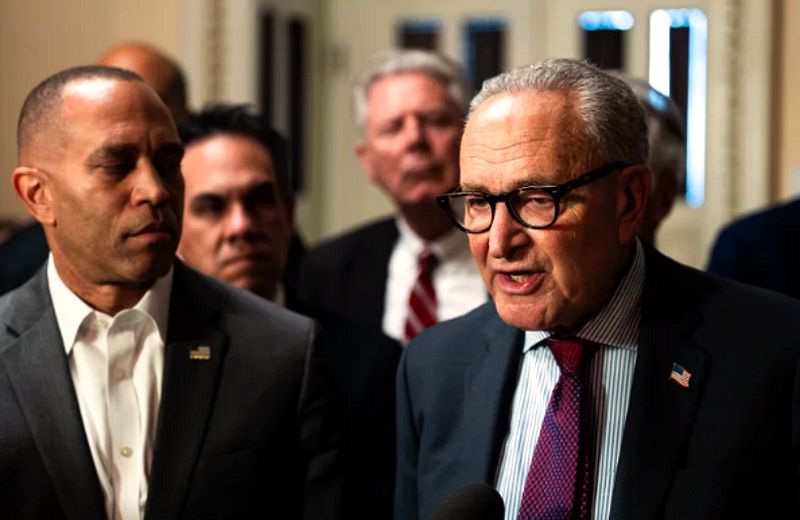
Senate Minority Leader Chuck Schumer is facing a growing rebellion within his party after eight Senate Democrats sided with Republicans to end the longest government shutdown in U.S. history, without securing the healthcare concessions Democrats had demanded. Furious progressives and House members are calling for Schumer’s resignation, accusing him of weak leadership and betrayal over the failure to extend Affordable Care Act (ACA) tax credits.
Backlash Erupts Against Schumer
The deal to reopen the government, reached late Sunday, has left Democrats bitterly divided. Progressive leaders and activists blasted Schumer for failing to secure ACA subsidies, a key demand in weeks of negotiations. “Chuck Schumer should step down as Senate minority leader immediately,” said Joseph Geevarghese, executive director of Our Revolution. “If he secretly backed this surrender and voted no to save face, he’s a liar. If he couldn’t keep his caucus in line, he’s inept.”
Progressive Fury and Public Condemnation
Criticism of Schumer intensified online, led by Rick Wilson, the ex-Republican strategist and co-founder of the Lincoln Project. “Last night, eight ‘moderate’ Democrats got played. Conned. Rooked. Pantsed. Pumped and dumped,” he wrote in a viral piece titled Schumer and the Hateful Eight Betray America. “It was a colossal leadership failure, and Chuck Schumer should resign as minority leader immediately if he had a shred of honor or shame.” Progressive organizations, including Indivisible and MoveOn, echoed those calls, accusing Schumer of betraying Democratic voters.
Democrats in Congress Join the Calls
Several House Democrats have publicly urged Schumer to resign. Representative Mike Levin of California said, “Chuck Schumer has not met this moment, and Senate Democrats would be wise to move on from his leadership.” Fellow Californian Ro Khanna and Michigan’s Rashida Tlaib also demanded change, with Tlaib saying, “Schumer… is out of touch with the American people. The Democratic Party needs leaders who fight and deliver for working people.” However, top Democratic senators have remained silent, and House leader Hakeem Jeffries defended Schumer, calling him “effective.”
Familiar Pattern of Party Division
This is not the first time Schumer has faced internal dissent. Earlier this year, he angered liberals by backing a Republican-led funding bill after initially opposing it. That decision sparked outrage from progressive groups and calls for new leadership, similar to the backlash unfolding now. Despite past criticism, Schumer weathered those storms and went on to lead Democrats through this most recent 41-day shutdown battle, collaborating closely with activist groups that are now turning on him.
The Compromise Deal Explained
The shutdown-ending agreement funds the government through January and guarantees only a symbolic future vote on ACA tax credits, offering Democrats no certainty of success. The deal was reportedly negotiated by a group of moderate senators, not by Schumer himself. While Schumer voted against the bill, progressives insist his leadership paved the way for the outcome. “He either blessed this surrender, or was incapable of leading his caucus to hold the line,” Indivisible wrote in a statement urging senators to replace him.
Republican Pressure and Political Spin
Republicans, meanwhile, have seized the moment to exploit Democratic infighting. Senate Majority Leader John Thune held multiple failed votes on GOP funding bills to pressure Democrats, while House Speaker Mike Johnson labeled the standoff the “Schumer shutdown.” Johnson accused Schumer of acting out of political fear, claiming, “He thinks AOC is going to challenge him or some other Marxist.” The GOP also used the impasse to frame Democrats as divided and ineffective ahead of next year’s elections.
Party Leaders Urge Restraint
Some Democrats are now calling for unity, wary that internal attacks could harm the party heading into campaign season. Suzan DelBene, chair of the Democratic Congressional Campaign Committee, circulated a memo urging members to “hold vulnerable Republicans accountable” instead of targeting Schumer. But progressive groups remain defiant, arguing that the minority leader’s approach represents a pattern of surrender. Whether the backlash fades or grows into a full-blown leadership challenge remains uncertain.