

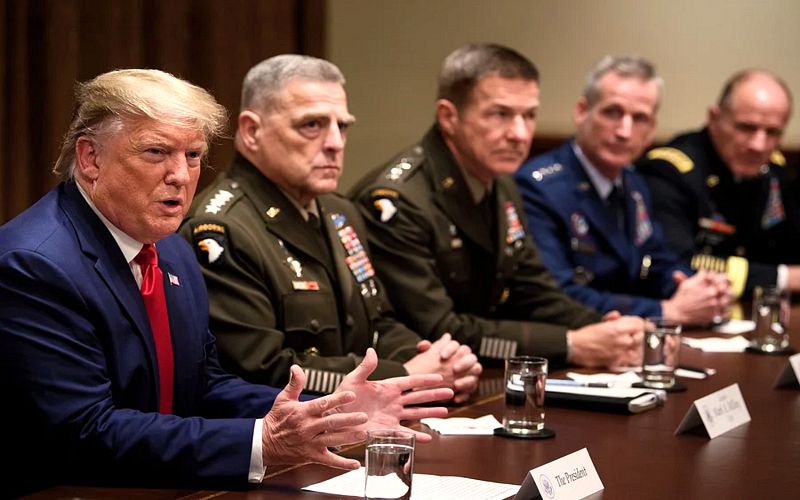
A coalition of former top military leaders has issued a stark warning about the growing politicization of the US armed forces as the Trump administration expands domestic troop deployments and removes senior commanders at an unprecedented pace. Their report, released Monday, cautions that recent actions have eroded public trust, undermined the military’s apolitical identity, and heightened tensions between the administration and US cities. With national guard troops deployed to multiple Democratic run cities and leadership upheavals inside the Pentagon, the report urges Congress to intervene before long-term damage becomes irreversible.
Rising Military Politicization
The warning comes after months of escalating friction between local governments and the Trump administration over national guard deployments. Former officials argue that domestic missions, including using guard troops for immigration enforcement, are feeding the perception that the armed forces are being steered toward partisan ends. They highlight the removal of senior officers and legal advisers as further evidence of political interference. “The use of troops, bases, and ceremonies in partisan settings has blurred the line between military service and political messaging, eroding morale and public trust in the military’s apolitical character,” the report states.
Authors Behind Report
The paper, titled The Perils of Politicizing the US Military, was written by six prominent former service secretaries and retired four-star leaders. Its authors include former Army Secretary Louis Caldera, former Air Force Secretary Deborah Lee James, former Navy Secretary Sean O’Keefe, retired Navy Admiral Steve Abbot, retired Coast Guard Admiral Thad Allen, and retired Army General George Casey. Their combined experience spans decades of command, policy making, and national security stewardship, underscoring concern within the highest levels of military leadership.
Deployments Fuel Tensions
The report lands as the Trump administration continues fighting court challenges over its effort to deploy the National Guard in Portland. In Washington, DC, where presidential authority over the guard is broader than in the states, troops were instructed to remain in place through at least February. Trump has also sent forces to Chicago and has threatened similar deployments to Democratic run cities such as San Francisco and New York, deepening political and legal conflict over federal intervention.
Pentagon Upheaval Under Hegseth
Months of instability inside the Pentagon have defined Defense Secretary Pete Hegseth’s tenure. Last month, Hegseth abruptly fired the Navy chief of staff. In May, he ordered a 20% cut to the military’s four-star generals and admirals. Since January, Trump and Hegseth have dismissed more than half a dozen top commanders. The administration has also removed the only two women serving as four-star officers, and in February, Hegseth fired Air Force General CQ Brown Jr, the chair of the Joint Chiefs of Staff and only the second Black leader ever to hold that role.
Consequences for Military Trust
Monday’s report warns that such actions risk long-lasting institutional harm. It argues that the “erosion of the armed forces’ apolitical character” could weaken recruitment, diminish retention, and create challenges in deterring adversaries and reassuring allies. “When service members, senior leaders, or military symbols are perceived as aligned with political agendas, the public begins to see the institution as partisan rather than national, and once eroded, that trust is difficult to rebuild,” the document states. The authors emphasize that rebuilding credibility would require sustained, transparent leadership.
Congressional Pushback Grows
Jack Reed, the top Democrat on the Senate Armed Services Committee, has urged Congress to curb the administration’s domestic troop deployments when local leaders have not consented. He stressed that lawmakers must consider long-term implications for the military’s integrity. “Congress has the Constitutional authority and moral obligation to stop this,” Reed said. “We are not powerless. We control the purse. We have oversight authority. We can pass legislation. And we must act now.”
Call for Legislative Safeguards
Reed and the former officials behind the report both call for new safeguards. Their recommendations include requiring the administration to notify Congress and publicly justify the removal of senior generals or admirals. They also propose clear standards mandating congressional approval for domestic military deployments except in genuine emergencies. The report urges lawmakers to adopt measures that demand “clear justification and post-action review of significant domestic deployments and high-level personnel changes,” aiming to shield the armed forces from partisan misuse.