

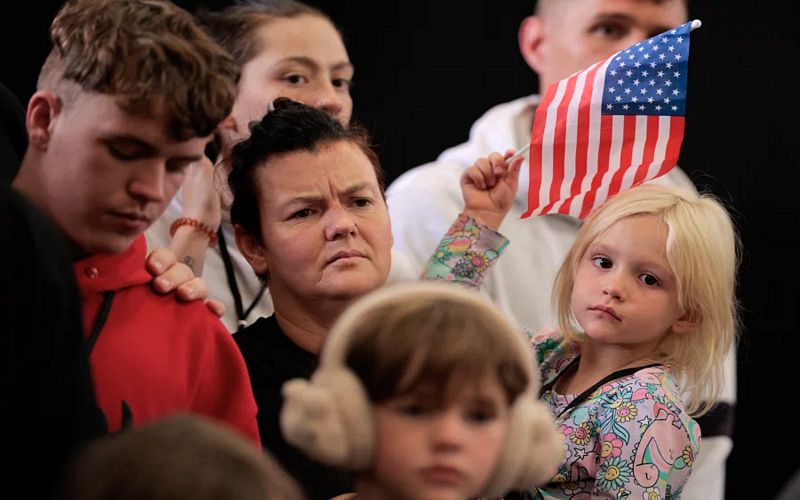
The Trump administration has announced a drastic cut to the number of refugees the United States will admit next year, setting the cap at just 7,500—one of the lowest figures in modern US history. According to the Federal Registry notice published Thursday, most of those limited spots will be allocated to white South Africans. This move has drawn widespread condemnation from humanitarian and refugee aid organizations. The decision marks a sharp reversal from previous US policies that welcomed hundreds of thousands fleeing war and persecution.
Read: Trump Coin Explodes as U.S.-China Trade Hope Ignites Crypto Frenzy
Record Low Refugee Cap
The new refugee ceiling represents a dramatic decline from the 125,000 admissions allowed under the Biden administration. The Trump administration offered no clear explanation for the cut, merely stating that admitting 7,500 refugees was “justified by humanitarian concerns or is otherwise in the national interest.” Reports of the administration’s plan had surfaced earlier after leaked documents revealed an intention to prioritize white South Africans in refugee processing.
Also read: Shutdown Chaos Leaves Sick Americans Without Lifesaving Telehealth Sessions
Humanitarian Groups Condemn Move
The announcement quickly sparked outrage among refugee advocacy groups. The International Refugee Assistance Project said, “This determination makes it painfully clear that the Trump administration values politics over protection.” The organization added, “By privileging Afrikaners while continuing to ban thousands of refugees who have already been vetted and approved, the administration is once again politicizing a humanitarian program.” It further described the move as “egregious” for excluding those stranded in dangerous conditions after years of rigorous security checks.
Also read: ‘The Extra Ds Stand for Dementia’ Gavin Newsom Taunts Trump’s Health Over Bizarre Post
Moral Standing Questioned
Krish O’Mara Vignarajah, CEO of Global Refuge, condemned the decision as a betrayal of America’s long-standing humanitarian commitments. “This decision doesn’t just lower the refugee admissions ceiling. It lowers our moral standing,” she said. Vignarajah emphasized that for decades, the refugee program had been “a lifeline for families fleeing war, persecution, and repression.” She warned that focusing admissions on one ethnic group “undermines the program’s purpose as well as its credibility.”
Also read: Trump,79, Walks the Wrong Way After Greeting Xi Jinping as Health Concerns Grow
Critics Decry Racial Bias
Aaron Reichlin-Melnick, a senior fellow at the American Immigration Council, called the move a complete distortion of the US refugee system’s founding principles. Writing on X, he said, “Since the US Refugee Program was created in 1980, it has admitted over two million people fleeing ethnic cleansing and other horrors. Now it will be used as a pathway for white immigration. What a downfall for a crown jewel of America’s international humanitarian programs.” His statement echoed growing concerns that the policy prioritizes race over need.
Also read: ICE Agent Points Gun at Veteran’s Head, Says “You’re Dead, Liberal,” Amid Chicago Raids
Trump’s Feud with South Africa
In February, Trump signed an executive order cutting financial aid to South Africa, accusing its Black-led government of “unjust racial discrimination” against white Afrikaners, descendants of Dutch and French settlers. His administration has claimed that South Africa’s land expropriation policies unfairly target white farmers, a claim the South African government has firmly rejected as false. Pretoria has repeatedly denied US accusations of racially motivated violence against Afrikaners, calling such assertions “politically charged fabrications.”
Also read: Masked ICE Agent Assaults and Throws Woman to the Ground During Protest in Colorado
Unequal Land Ownership Debate
The controversy over South African land ownership continues to fuel tension between Washington and Pretoria. According to Action for Southern Africa, 72% of South Africa’s farms and agricultural holdings are owned by white individuals, who make up just 7.3% of the total population. In contrast, Black Africans, representing 81.4% of the country, own roughly 4% of the land. Despite these stark inequalities, the South African government insists its reforms aim to redress apartheid-era injustices rather than persecute white citizens.
Also read: ICE Clashes With Chicago Residents as Halloween Parade Canceled
History of Refugee Reductions
This is not the first time Trump has drastically cut refugee resettlement. During his first term, the cap was set at 15,000 for the 2021 fiscal year and 18,000 for 2020—both historic lows at the time. The new 7,500 limit now represents the most severe contraction of the US refugee program since its inception in 1980, signaling a continued shift away from America’s role as a global safe haven for those fleeing conflict and persecution.