
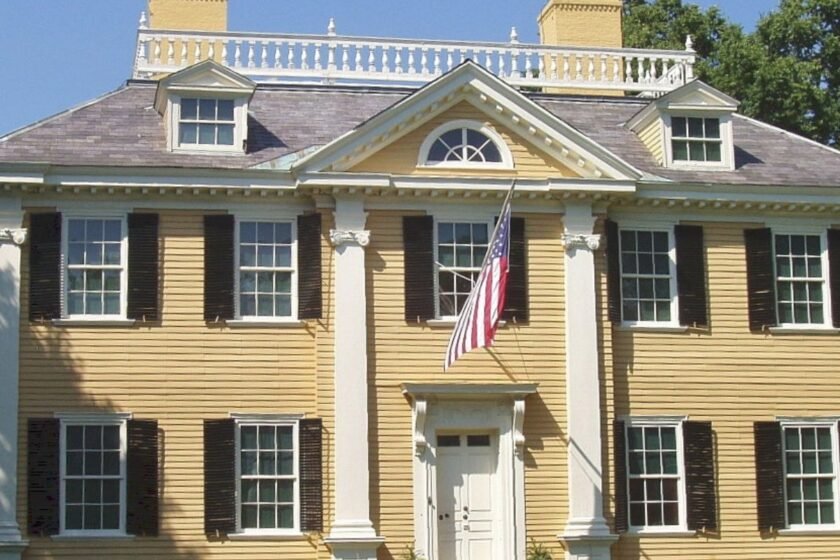

A Marvel of Mail-Order Architecture
The Magnolia was one of the most iconic homes offered in the Sears Modern Homes catalog, which operated from 1908 to 1940.
Introduced in 1918, this grand ten-room mansion stood apart from the other mail-order homes due to its size, elegance, and price.
Inspired by the home of poet Henry Wadsworth Longfellow in Cambridge, Massachusetts, it was a standout model that epitomized early 20th-century American suburban aspirations.
The Sears, Roebuck & Co. Home Revolution

Sears, Roebuck & Co. revolutionized homeownership in America by offering ready-to-assemble home kits through its mail-order catalog.
From 1908 to 1940, Sears sold more than 70,000 homes across the country.
Customers could select from various models, receive all the necessary pre-cut lumber, nails, windows, and instructions, and either build it themselves or hire a local contractor.
The Magnolia was the most expensive and elaborate design Sears ever offered.
It reflected the Colonial Revival architectural style but also incorporated elements of the Foursquare design, which was popular in the early 20th century for its boxy shape and functional layout.
Features of the Magnolia


The Magnolia’s grand design made it the pinnacle of Sears’ home catalog. It offered features that were rarely found in mail-order homes:
•Ten Spacious Rooms: Plenty of space for large families or entertaining guests.
• Colonial Revival Facade: Symmetrical design with classic columns and a grand entrance.
• Customizable Layouts: Buyers could modify the floor plan and select materials.
• Ornate Interior Details: Included fireplaces, hardwood floors, built-in cabinetry, and decorative moldings.
• Modern Conveniences for Its Time: Running water, central heating, and electric wiring were included.
• Large Wraparound Porch: Emphasizing elegance and outdoor living.
Buyers also received detailed blueprints and a list of recommended tools to construct their dream home.
Despite its grandeur, building a Magnolia was still cheaper than hiring an architect and contractor for a custom-built mansion.
The Popularity and Rarity of the Magnolia

Due to its high cost and large size, very few Magnolias were ever built.
Estimates suggest that only a few dozen were constructed, and today, only seven known examples remain standing.
Some of these homes have been carefully preserved and restored, while others have been lost to demolition.
Surviving Magnolias


One of the most famous Magnolia homes stood in Lincoln, Nebraska, but was sadly demolished in 1985.
The remaining Magnolias are scattered across the United States, with documented examples in:
• South Carolina
• North Carolina
• Ohio
• Indiana
• Pennsylvania
•Alabama
These rare homes are cherished by architectural historians and enthusiasts who appreciate Sears’ impact on American residential design.
The End of Sears Homes

The Great Depression significantly impacted the Sears home business.
By the 1930s, the company saw a steep decline in home sales as economic hardships made purchasing even the most affordable kit homes difficult.
By 1940, Sears discontinued its Modern Homes program, closing the chapter on one of the most innovative housing experiments in U.S. history.
While Sears stopped selling mail-order homes, the impact of their architectural designs, innovative marketing, and affordable homeownership model remains influential today.
The Magnolia’s Legacy

Although the Sears Magnolia was built in limited numbers, its legacy endures as one of the most ambitious designs from the Sears Modern Homes catalog.
It represents an era when mail-order homes democratized homeownership, allowing families across America to build quality homes at an affordable price.
Today, surviving Magnolias are considered architectural treasures.
Homeowners and preservationists work to maintain their original Colonial Revival elegance, ensuring that these homes continue to stand as testaments to early 20th-century innovation in home design.
Why the Magnolia Still Matters?

• It exemplifies early 20th-century American architecture.
• It represents the innovation of mail-order home kits.
• It showcases the ambition of Sears’ Modern Homes program.
• It reminds us of an era when homeownership became accessible to more Americans.
Conclusion

The Sears Magnolia was not just a house; it was a statement of luxury, design, and innovation.
While few remain today, these homes serve as an enduring reminder of how one catalog company revolutionized American homeownership.
Whether admired in books, preserved in history, or still standing in quiet neighborhoods, the Magnolia remains one of the most fascinating pieces of architectural history from the early 20th century.
If you ever come across one of these magnificent homes, know that you’re looking at a rare and remarkable piece of American heritage.
