
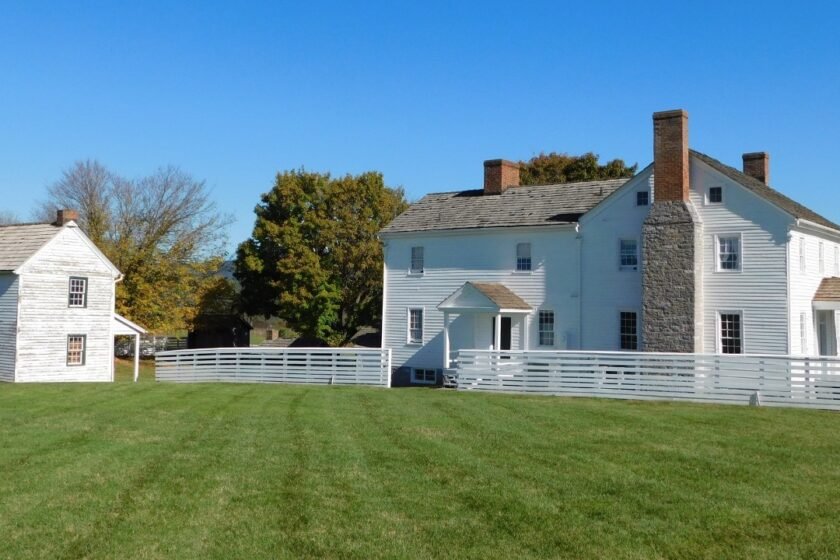

The Bushong House, situated on the Virginia Museum of the Civil War grounds, is celebrating its bicentennial this year. Built in 1825, this historic home has witnessed pivotal moments in American history, including the Civil War. It serves as a testament to the enduring legacy of the Bushong family and the broader cultural heritage of the Shenandoah Valley. The house’s significance extends beyond its architectural beauty, offering insights into how families lived and interacted during the early 19th century.
The Bushong Family’s German Heritage

The Bushong family traces its roots to Germany, likely originating from the Alsace-Lorraine region, a historically contested area between France and Germany. Seeking new opportunities, they immigrated to America, settling first in Augusta and Page counties before moving to Shenandoah County. In 1791, Henry Bushong, grandson of the first immigrant, acquired 260 acres in the fertile Shenandoah Valley. His son Jacob and Jacob’s wife, Sarah Strickler, later built their home there. As part of a wave of German immigrants, the Bushongs brought strong farming traditions and a commitment to self-sufficiency, shaping the region’s agricultural and cultural landscape.
Expansion of the Bushong House

The Bushong House underwent significant architectural transformation from its humble beginnings as a four-room log cabin in 1818. In 1825, Jacob and Sarah constructed a larger house in the federal architectural style, characterized by Roman-inspired columns and a symmetrical design. This style was popular during that era and is reminiscent of iconic buildings like Monticello. The house’s design reflects the family’s growth and their desire for a more spacious and elegant home.
Daily Life in the Bushong Household

Life on the Bushong farm revolved around agriculture, family, and faith. Jacob and Sarah Bushong raised six children in their home, instilling in them the values of hard work and perseverance. Days were filled with tending to crops, maintaining livestock, and managing household chores. Women in the household engaged in sewing, cooking, and preserving food, while the men handled plowing and construction. Social customs dictated that children were to be well-behaved, especially in the formal parlor, which was reserved for high-status visitors or important family events. The Bushongs, like many of their neighbors, lived according to a self-sufficient lifestyle, making and trading goods within their community. Despite the challenges of 19th-century rural life, the family flourished, and their home symbolized their resilience and dedication.
The Battle of New Market and the House’s Role

On May 15, 1864, the peaceful life of the Bushong family was shattered when the Battle of New Market erupted around them. As the Confederate and Union forces clashed on their farmland, three generations of Bushongs took shelter in the cellar beneath their home. The family could hear the thunderous roar of cannons and see the smoke rising from the battlefield. From their hiding place, they watched cadets from the Virginia Military Institute advance across their fields, playing a crucial role in the Confederate victory. The Bushongs’ experience was one of fear and uncertainty, but their home remained standing, bearing witness to the horrors of war that unfolded in their once-tranquil surroundings.
A Home-Turned Hospital

In the aftermath of the battle, the Bushong House was transformed into a makeshift hospital, caring for wounded soldiers from both sides. Sarah Bushong played a significant role in organizing the effort, keeping a ledger of the soldiers who found refuge in her home. Some stayed for weeks, tended to by family members and local volunteers. The house saw its rooms repurposed for medical care, with the parlor becoming a recovery area and the cellar serving as a space for the most severely injured. This period marked one of the darkest chapters in the home’s history, as the Bushongs bore witness to the suffering of young men caught in the chaos of war.
Post-War Resilience

Following the war, the Bushong family faced the immense challenge of rebuilding their lives. Soldiers had trampled their farmland, crops were lost, and their homes had been hospitals rather than residences. Yet, they persevered, returning to their agricultural roots and slowly restoring what had been damaged. The family remained on the land until the early 1900s, continuing the farming traditions that had sustained them for generations. However, economic hardships eventually led to the sale of the property in 1942, marking the end of the Bushong family’s direct connection to the farm. Their resilience, however, ensured that their legacy lived on, as the house remained an enduring symbol of endurance and adaptation.
The 1825 Farmhouse

Built in 1825 to accommodate the growing Bushong family, this stately farmhouse embodies the Federal architectural style, its symmetrical three-bay facade, pedimented portico, and refined yet practical design. The house, resting on a sturdy limestone foundation, was constructed using materials and techniques common in the Shenandoah Valley, including wooden shingle roofing and intricate interior woodwork. By the mid-19th century, expansions allowed the home to shelter three generations, reflecting the family’s growth and evolving needs.
The Bank Barn

Built into the hillside for insulation and accessibility, the Bushong family’s bank barn played a crucial role in sheltering livestock, storing grain, and supporting farm work. Unlike many barns in the Shenandoah Valley, it survived General Sheridan’s scorched-earth campaign, as noted in an 1865 letter. However, in 1939, a lightning strike destroyed the original structure. Rebuilt in 1942 on its original stone foundation, the barn stands as a testament to resilience and renewal in rural America.
The Blacksmith Shop

The Bushongs supplemented their farm income with blacksmithing and wheelwright work, both essential trades in their rural community. Harrison Bushong, known for his mechanical skills, operated the shop, repairing tools and farm equipment for local farmers. In the 1840s, he designed and built an early wheat threshing machine, submitting a model to the U.S. Patent Office—though the patent was never granted. By 1850, census records list Harrison as a “machine maker,” reflecting the era’s shift toward mechanized farming.
Hen House

Chickens and eggs were daily staples in the Bushong household, with young children like four-year-old William and six-year-old Sarah tasked with collecting eggs each morning. During the day, chickens roamed freely, scratching for food in the yard, while at night, they perched safely in the hen house. Based on period accounts, the farm’s reconstructed fencing reflects a practical 19th-century design—closely spaced boards at the bottom kept chickens from wandering while deterring predators like foxes and raccoons. This simple yet essential aspect of farm life provided food for the family and taught responsibility to the youngest Bushongs, reinforcing the rhythms of daily life on a working farm.
Meat and Loom House

This versatile structure played a crucial role in the Bushong household, serving as both a weaving room and a smokehouse. Before the Civil War, Sarah Bushong often bought fabric from local merchants, but as wartime shortages made textiles scarce, families returned to weaving their own cloth. Weaving became not only a necessity but also a symbol of resilience. A family letter from 1865 describes the struggle, with clothing patched and repurposed until it was nearly unrecognizable. The log section of the building functioned as a smokehouse, where meat was cured to ensure a steady food supply. Together, these spaces reflected the Bushong family’s self-sufficiency, allowing them to endure both the hardships of war and the daily demands of farm life.
The Bake Oven

Baking in the Bushong household was a labor-intensive process in a free-standing brick oven designed to keep heat and smoke away from the main house. To prepare it, a fire was built inside to heat the bricks, and once they reached the proper temperature, the coals were removed before placing bread and other baked goods inside. Essential tools, including a long-handled wooden peel for handling pans, a swab to cool the surface, and an ash hoe, helped ensure efficient baking. Despite the effort involved, the oven provided a reliable source of fresh bread—a staple of the Bushong family’s diet—demonstrating the resourcefulness and self-sufficiency required for daily farm life in the 19th century.
The Ice House and Dairy

Built in 1871, the Bushong ice house was essential for food preservation, using natural insulation to keep perishable goods fresh long into the summer. Large ice blocks were harvested from nearby ponds each winter, packed tightly in sawdust and straw, and stored within the structure’s thick limestone walls. As the ice gradually melted, a stone trough in the front section collected runoff, providing a cool space to store milk and keep the butter firm. In an 1872 letter, Anderson Bushong expressed his gratitude for the ice house, noting the comfort of enjoying cold milk and butter on a sweltering Virginia summer day. This simple yet effective technology showcased the ingenuity of 19th-century farm life, ensuring the family had access to fresh provisions even in the heat of summer.
The Summer Kitchen

The Bushong family’s summer kitchen, a separate structure from the main house, played a crucial role in daily life, keeping heat and cooking odors at bay. It was primarily overseen by Sarah Bushong, her daughter Betsy, and daughter-in-law Elizabeth, alongside enslaved laborers who worked in the household. Census records from 1820 to 1860 document enslaved individuals on the farm, including a woman named Mary and her son Israel. The kitchen’s lofted sleeping quarters likely served as their living space. This structure stands as both a functional part of the farmstead and a reminder of the complex history of labor on Southern farms, highlighting the contributions of those who worked tirelessly to sustain the household. Today, it offers visitors a window into the realities of 19th-century domestic life and the unseen hands that shaped it.
The Wheelwright Shop

The wheelwright shop was essential to the Bushong farm, serving as a hub for crafting and repairing wagon and buggy wheels—critical for transportation in rural Virginia. This trade required precision, as spokes had to be cut and set at exact angles to ensure durability and balance. Harrison Bushong, the farm’s resident wheelwright, was highly regarded for his skill, with family letters praising his craftsmanship and dedication to the trade. Beyond wheels, the shop functioned as a general carpentry space, producing essential farm implements and making wooden repairs to tools and structures. As mechanized farming grew in the mid-19th century, shops like this played a vital role in supporting agricultural communities, ensuring that wagons, plows, and other equipment remained in working order.
Preserving History

After passing out of the Bushong family’s hands, the property was purchased by George Randall Collins, a Virginia Military Institute graduate, in 1944. Recognizing its historical significance, Collins began efforts to preserve the home and commemorate the events that had taken place there. In 1964, the property was deeded to VMI, officially establishing it as a memorial to the Battle of New Market. This act of preservation marked a milestone in Civil War battlefield conservation in the Shenandoah Valley, ensuring that future generations could learn from and experience the site firsthand.
Bringing History to Life

Today, the Bushong House serves as a vital part of the Virginia Museum of the Civil War, offering visitors an immersive look into 19th-century life. The home’s interior has been carefully recreated, with period-accurate furniture and decor, to reflect its original appearance. One room is arranged as a field hospital, providing a stark reminder of the home’s wartime role. Historical interpreters share the Bushong family’s story and the home’s Civil War significance, offering visitors a tangible connection to the past through guided tours and educational programs.
Why the Bushong House Matters Today

The Bushong House is more than just a relic of the past—it is a window into the experiences of ordinary people who lived through extraordinary times. Whether as a family home, a Civil War refuge, or a museum, the house has endured as a testament to the importance of historic preservation. In an age where modernization threatens to erase the past, places like the Bushong House remind us of where we came from and the lessons we can learn from those who came before us. By safeguarding such sites, we ensure that history remains accessible, engaging, and relevant for future generations.