
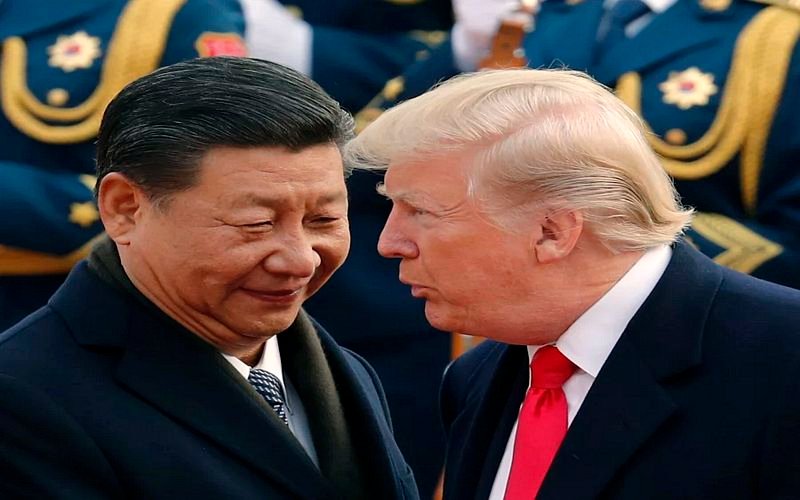
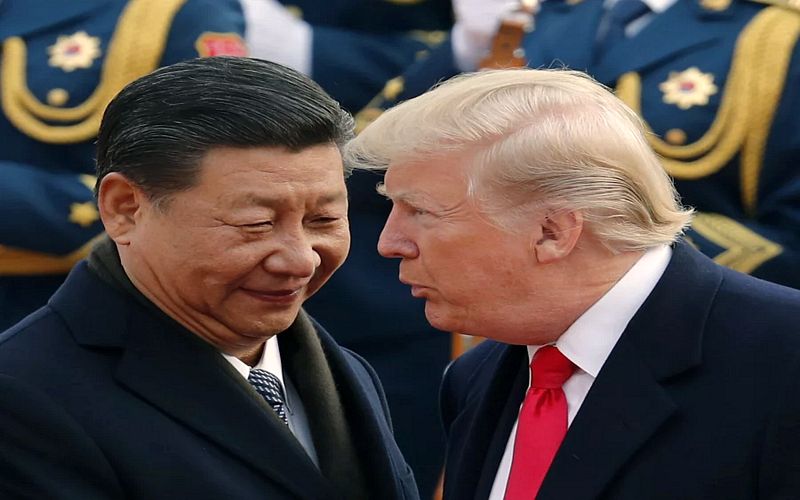
As the world watches closely, US President Donald Trump and Chinese President Xi Jinping are set to meet for the first time since Trump’s return to power. The long-awaited meeting, taking place on the sidelines of the APEC summit in Seoul, could mark a turning point in the months-long US-China trade war that has destabilized global markets. Both sides are pushing for a breakthrough agreement that could ease tensions over rare earths, tariffs, and technology restrictions, signaling a potential reset in the world’s most crucial bilateral relationship.
Read: Trump Praises Japan’s First Female Prime Minister, Takaichi, During Historic Meeting
First Meeting in Years
Trump and Xi have not met in person since 2019, a gap marked by rising geopolitical and economic friction. The years between have seen the war in Ukraine, worsening mistrust over China’s technological ambitions, and the fallout from an imbalanced trade relationship. Trump, speaking aboard Air Force One, struck an optimistic tone: “I think we’re going to have a great meeting with President Xi of China, and a lot of problems are going to be solved.”
Also read: Trump Administration to Overhaul ICE Leadership in Push for Stronger Deportations
Taiwan Question Avoided
Trump suggested that Taiwan, a historically sensitive issue between Washington and Beijing, may not feature prominently in discussions. “I don’t know that we’ll even speak about Taiwan. I’m not sure. He may want to ask about it. There’s not that much to ask about. Taiwan is Taiwan,” Trump remarked. Meanwhile, Chinese officials reiterated they would “never” rule out the use of military force to reclaim the island, emphasizing their long-term reunification goal.
Also read: Newsom Critiques Trump’s Cognitive Fitness, Sparking Debate Over Health Transparency
Rare Earths Take Center Stage
Rare earth minerals, critical to industries ranging from defense to electronics, will dominate the agenda. China currently controls 70% of global mining and 90% of processing capacity, giving it significant leverage. Earlier this month, Beijing tightened export restrictions on rare earths, citing national security concerns. The move followed Washington’s expansion of semiconductor export limits, escalating tensions further.
Also read: Trump Hints at Desire for Third Term but Rules Out VP Run
Tentative Trade Concessions
Preliminary negotiations in Kuala Lumpur hinted at a possible compromise. Beijing appeared willing to delay its new export controls for a year in exchange for Washington freezing chip export restrictions. Analysts say such an arrangement could offer temporary economic relief to both sides, though critics in Washington warn that easing tech restrictions could jeopardize US long-term security.
Japan Strengthens Alliance
In a strategic move, Trump recently signed a rare earth cooperation agreement with Japan’s Prime Minister, Sanae Takaichi. The deal aims to secure joint mining and stockpiling of critical minerals, mirroring Japan’s decade-long effort to cut its dependency on China from 90% to 60%. The White House called it a “mutually complementary” partnership that strengthens economic resilience.
Also read: Biden Calls Trump Era ‘Dark Days’ and Urges Optimism for America’s Future
Shifting Global Trade Patterns
While Washington seeks alternatives, China is diversifying its own trade routes. On Tuesday, it upgraded its free trade agreement with the ASEAN bloc, now its largest trading partner, totaling $771 billion in trade last year compared to $659 billion with the US. The recalibration underscores Beijing’s intent to insulate its economy from Western volatility.
Also read: Trump Administration Asks Supreme Court to Fire US Copyright Director
Tariff War’s Critical Deadline
Both sides face a looming November 10 deadline to finalize a deal before tariff levels spike again. The average Chinese tariff on US exports currently stands at 32.6%, while the US rate on Chinese goods is 57.6%. In April, tariffs had surged beyond 130%, effectively freezing trade between the two largest economies. “Both want to avoid a return to the very high tariffs that they threatened each other with earlier this year,” said Bonnie Glaser of the German Marshall Fund.
Also read: Trump Hints at Third Term Ambition, Says “I Would Love to Do It” Despite Constitutional Limit
Prospects for Cooperation
Despite deep divisions, both governments are signaling openness to dialogue. China’s Foreign Minister Wang Yi recently urged a “spirit of equality, respect, and mutual benefit” in talks with US Secretary of State Marco Rubio. The two leaders are also expected to discuss fentanyl control and finalize the pending TikTok deal. Analysts believe this meeting could lay the groundwork for a more stable phase in US-China relations, as both sides recognize the cost of continued economic warfare.
Also read: Congress Urges Trump to Refrain from Using Military Against Americans, Citing Posse Comitatus Act
A Chance for Reset
Feng Chucheng of Hutong Research noted a shifting perspective in Washington: “There’s a growing revelation in the US that ‘mutually dependent coexistence may be beneficial’.” For Trump and Xi, the Seoul summit offers more than a policy exchange; it is a test of leadership, leverage, and their capacity to stabilize an increasingly fragmented global economy.