
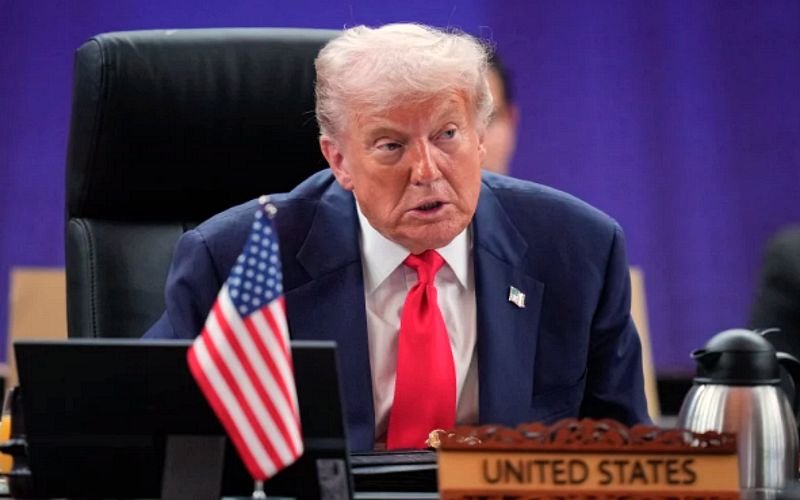
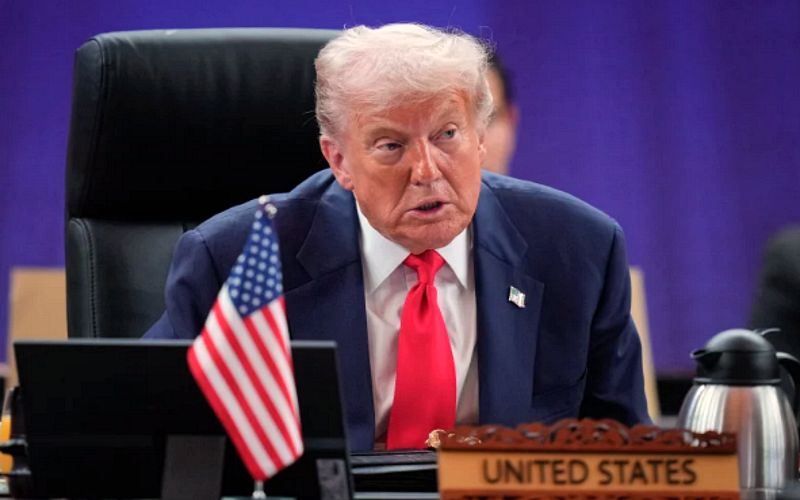
In a dramatic escalation of global nuclear tensions, U.S. President Donald Trump has directed the Pentagon to begin testing nuclear weapons, citing the need to match Russia and China. The announcement came shortly before his meeting with Chinese President Xi Jinping in South Korea, a session aimed at cooling the ongoing trade war. Trump’s remarks mark a stark shift in U.S. nuclear policy, reviving a practice halted more than three decades ago. The move has sparked alarm among lawmakers, defense officials, and international observers.
Trump’s Truth Social Declaration
Trump made the announcement on Truth Social, declaring, “Because of other countries’ testing programs, I have instructed the Department of War to start testing our Nuclear Weapons on an equal basis. That process will begin immediately.” His post, made less than an hour before meeting Xi Jinping, underscored his intent to demonstrate U.S. military strength amid rising geopolitical friction. The timing of the post also suggests a deliberate attempt to send a message ahead of key diplomatic talks.
Meeting with Xi Jinping
The statement coincided with Trump’s meeting with Chinese President Xi Jinping in South Korea — their first since 2019. The two leaders reportedly sought to ease tensions surrounding the trade war, though Trump’s nuclear remarks overshadowed the diplomatic effort. Speaking later aboard Air Force One, Trump said he still hoped for “denuclearisation” and added, “The US is talking to Russia about that. And China would be added to that if we do something,” leaving observers uncertain about his actual intentions.
Decades Since Last U.S. Nuclear Test
The United States last conducted a full-scale nuclear weapons test in 1992, under President George H.W. Bush, who later declared a moratorium on underground testing. Since then, the U.S. and other nuclear powers have relied on simulated nuclear explosions, subcritical tests, and computer-based experiments to maintain their arsenals. Trump’s call for renewed testing breaks from decades of U.S. policy and raises questions about compliance with international non-proliferation norms.
Global Nuclear Testing Landscape
While no country other than North Korea has conducted a full nuclear test since 1998, Russia and China have reportedly carried out simulated tests to advance their weapons programs. Trump’s statement to test “on an equal basis” was ambiguous, leaving unclear whether the U.S. would conduct physical detonations or limit testing to simulations. Pentagon officials have not yet commented on what form the testing will take, deepening uncertainty within the defense community.
China and Russia’s Response
China’s foreign ministry urged Washington to honor its commitments under the Nuclear Non-Proliferation Treaty (NPT). “We hope the US will take actions that contribute to regional peace, rather than the opposite,” said ministry spokesperson Guo Jiakun, adding that China remains committed to “peaceful development” and “defensive national security policies.”
Meanwhile, Russian President Vladimir Putin recently announced successful tests of the Burevestnik nuclear-powered cruise missile and the Poseidon super torpedo, weapons capable of devastating coastal cities. The Kremlin described these as measures to “ensure national security.” Trump called Putin’s announcement “not appropriate,” though Moscow confirmed it had informed Washington in advance.
Lawmakers Push Back
Trump’s directive has already met resistance in Congress. Nevada Representative Dina Titus strongly opposed the move, posting on X, “Absolutely not. I’ll be introducing legislation to put a stop to this.” Her state hosts the Nevada National Security Site, the traditional location for U.S. nuclear tests. The last full test, “Divider,” took place there in 1992. Despite the moratorium, the site remains capable of hosting future tests if authorized.
Escalating Arms Race Concerns
Despite public statements by both Moscow and Washington about curbing the arms race, progress remains stagnant. The Kremlin has criticized Trump’s pursuit of a missile defense shield known as the “Golden Dome,” which he claims would make the U.S. impervious to attack. During his first term, Trump reportedly sought to increase America’s nuclear arsenal “tenfold.” His past declaration from 2016 resurfaced in the wake of this announcement: “The United States must greatly strengthen and expand its nuclear capability until such time as the world comes to its senses regarding nukes.”