

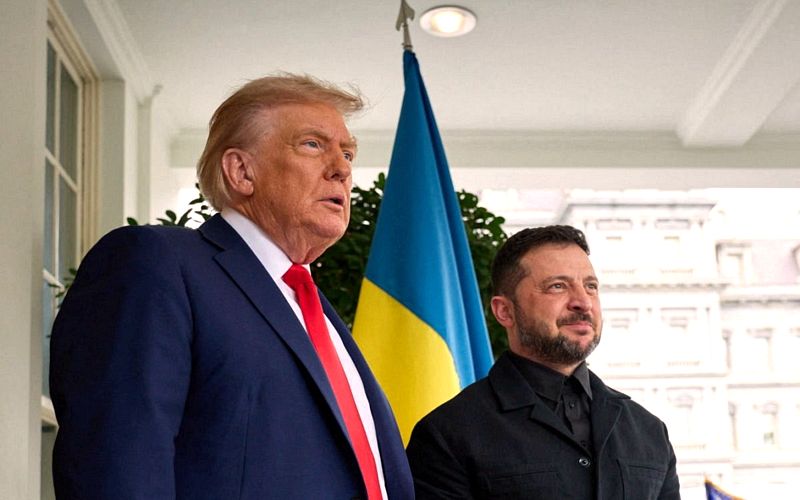
US President Donald Trump has said he may authorize the transfer of Tomahawk long-range cruise missiles to Ukraine, signaling what he described as “a new step of aggression” in Kyiv’s war with Russia. The statement came after a second phone call between Trump and Ukrainian President Volodymyr Zelensky over the weekend, during which Zelensky pushed for advanced weaponry to strike deeper into Russian territory. Moscow has warned that such a move would represent a severe escalation, potentially destabilizing US-Russia relations further.
Read: Lawmaker Accuses Mike Johnson of ‘Massive Epstein Cover-Up’ Amid Growing GOP Pressure
Trump Weighs Missile Decision
Speaking to reporters aboard Air Force One, Trump said he had not yet made a final decision but suggested the possibility was on the table. “We’ll see… I may,” he told reporters when asked if the U.S. would send Tomahawks to Ukraine. The remarks came as Trump traveled to Israel, adding that he might discuss the potential delivery with Russia. “I might tell them [Russia] that if the war is not settled, that we may very well, we may not, but we may do it,” he said, hinting that the move could serve as a pressure tactic.
Also read: MAGA Revolt Erupts Over Trump’s Plan to Host Qatari Air Force Facility in Idaho
Zelensky Pushes for Long-Range Weapons
In his recent calls with Trump, President Zelensky emphasized Ukraine’s need for stronger military capabilities, including long-range missiles and improved air defenses. Kyiv has repeatedly appealed for advanced Western arms to counter relentless Russian attacks that have devastated infrastructure and caused severe power shortages. Ukrainian officials argue that such weaponry would allow them to target strategic sites far behind Russian lines and change the course of the conflict.
Also read: Nobel Peace Prize Winner Dedicates Award to Trump After His Shocking Snub
Russia Issues Stern Warning
Moscow responded sharply to talk of the U.S. possibly supplying Tomahawks, calling it a dangerous escalation. Russian officials warned that any delivery of long-range missiles would have “grave consequences” for both the conflict and bilateral relations. Kremlin spokesperson Dmitry Peskov reiterated last month that such weapons would not alter the overall balance of the war, saying, “Whether it’s Tomahawks or other missiles, they won’t be able to change the dynamic.”
Also read: White House Condemns Nobel Committee for ‘Snubbing’ Trump in Peace Prize Decision
The Tomahawk’s Strategic Power
Tomahawk cruise missiles, capable of striking targets up to 2,500 kilometers (1,500 miles) away, would allow Ukraine to reach Moscow and other deep interior targets for the first time. The precision-guided missiles, typically launched from ships or submarines, have been used by the U.S. in multiple conflicts, including Iraq and Syria. Military analysts say their deployment to Ukraine would mark a significant escalation and could provoke a severe Russian response.
Also read: “Keep Your Mouth Shut”: Capitol Chaos Deepens as Shutdown Drags Into Third Week
Trump’s Calculated Ambiguity
While Trump did not confirm whether he would move forward with the transfer, his remarks suggest he is using the possibility as leverage in talks with both Kyiv and Moscow. “Do they [Russia] want Tomahawks going in their direction? I don’t think so,” he said pointedly. His administration has maintained a delicate balance between supporting Ukraine and avoiding confrontation with Russia, but this latest signal suggests the balance may soon shift.
Also read: Horror at Huntington Beach: Out-of-Control Helicopter Slams Palms Near Swimmers
Past Indications of Escalation
Hints of such a move have surfaced before. Last month, Trump’s special envoy to Ukraine, Keith Kellogg, told Fox News that the president had authorized strikes deep into Russian territory, saying, “There are no such things as sanctuaries” in the ongoing war. The remark fueled speculation that the administration was considering expanding Ukraine’s offensive capabilities beyond the defensive limits previously observed by Western allies.
Also read: Trump Vows to Pay Troops Amid Deepening Government Shutdown
War Enters Dangerous New Phase
Russia’s full-scale invasion of Ukraine, launched in February 2022, continues to grind on with heavy bombardments and mounting civilian casualties. Ukrainian cities, including Kyiv, have been repeatedly struck by drones and missiles, particularly targeting the nation’s energy infrastructure. As the war drags into its third year, the potential delivery of Tomahawks could push the conflict into its most volatile phase yet, drawing global attention and concern.